
)
Niftylift returns to the 10m class with the all-new HR10
Two all-electric versions, one optimised for width and one for low weight, made their first public appearance on Niftylift’s stand at Vertikal Days
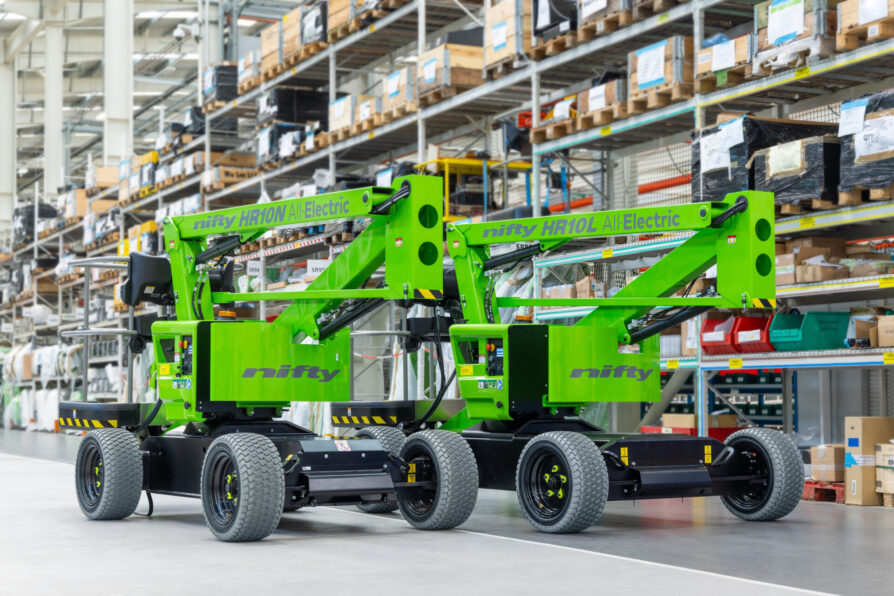
Niftylift has launched the HR10, an all-new all-electric compact boom lift available in two versions: the HR10NE, optimised for narrow access, and the HR10LE, optimised for low weight..
It is the first Niftylift machine in the 10m class since the original HR10 was discontinued in 2015, and it is a new design rather than a revival. Its chassis and boom are derived from the modern HR12 family, and it shares nothing structural with the machine whose name it inherits.
Both versions share the same working envelope: 10m working height, 8m platform height and 4.3m of outreach, from a 1.2m by 0.85m platform. Both are all-electric, both stow at 1.98m and both are fitted with SiOPS, ToughCage and Niftylink as standard.
What separates them is the constraint each is built to overcome.
The HR10NE is built for sites where access is tight – the N denotes the narrow chassis – such as narrow-aisle warehousing, occupied buildings and spaces where plant is already installed. Narrow booms have traditionally carried a weight penalty. This one does not.
Some floors rule out a boom lift on weight alone, before access even becomes the question. The HR10LE is designed for those, with a maximum point load low enough to bring raised access floors and other weight-sensitive environments within reach.
Rather than place the two machines in the open, Niftylift showed them inside a dedicated enclosure on Stand 227, accessible through the company’s hospitality unit, this not only raised anticipation but demonstrated how they fit into a restricted space.
Both machines shown at Newark were prototypes, nevertheless they attracted not only interest, but significant pre-sales.
John Keely, Managing Director at Niftylift, said, “The 10m class matters again in a way it didn’t a decade ago. More jobs are happening inside occupied buildings, on finished floors and in spaces that were never designed to accommodate machinery. Some of those jobs are limited by how narrow a machine can be, and some by how little weight the floor will take. We have built for both rather than compromising on either. Neither of these is a scaled-down version of something bigger.”
Look out for more information in the October issue of ILH.

ILH free trial
Click here to get your free copy of ILH magazine and the bi-weekly e-Newsletter
New Issue
ILH September 2026
In this month's issue