)
UK Construction mandates secondary guarding on scissor lifts
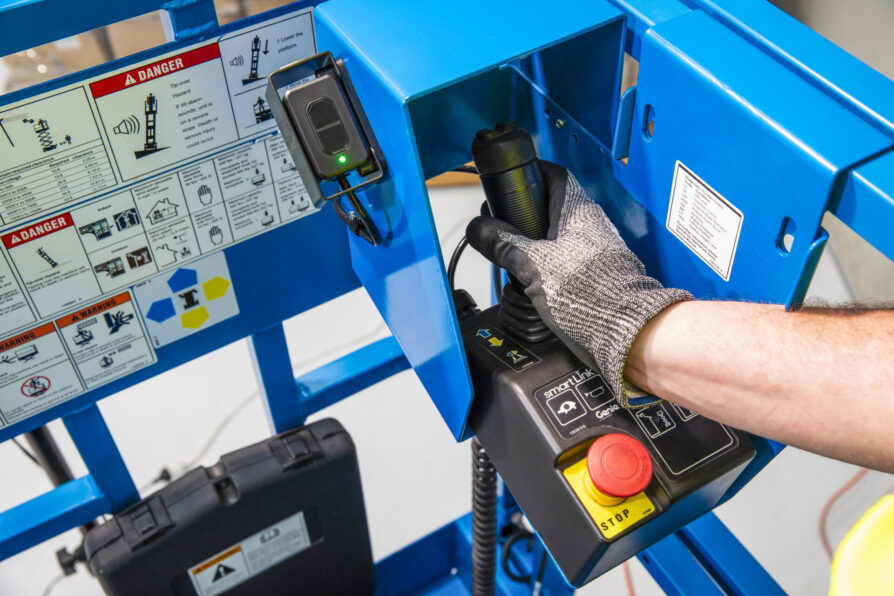
The UK construction industry is moving decisively to protect scissor lift operators, with many Tier 1 contractors introducing secondary guarding requirements for all MEWPs on their projects, effective as of the 1 January 2026.
The move to mandate is being led by some of the largest UK contractors including Mace, Balfour Beatty, Skanska and Laing O’Rourke. It follows a similar move in 2014 when UKCA (now Build UK) issued a mandate for secondary guarding on boom lifts at all Tier 1 sites.
One of the first major projects to enforce the scissor lift secondary guarding requirement was Hinkley Point C (HPC), operated by BYLOR, a joint venture between Bouygues and Laing O’Rourke.
“Hinkley Point C (“HPC”) is the biggest construction site in Europe, and as the first mega-site to mandate secondary guarding on all forms of MEWPs, we’ve seen first-hand the impact this change can make,” said Andy Scone, construction manager at HPC, who was instrumental in driving the change.
“With more than 1000 MEWPs on site fitted with secondary guarding, we were able to work closely with EQSS to provide feedback that helped develop a new firmware configuration, improving safety across the board. One of the key outcomes for our team was the ability for operators to use pedestrian mode instead of ducking through doorways, which has made operations both safer and more efficient. This level of collaboration and innovation has been vital in shaping how secondary guarding continues to evolve for real-world conditions.”
Machine suppliers and hire companies across the UK are updating their fleets with systems such as EQSS OverWatch, in response to the mandates now in effect. For many, this is an opportunity to work more closely with their contractor customers and deliver tangible safety improvements.
“At the end of the day, it’s about saving lives,” said Will Temple, head of powered access at Sunbelt Rentals UK. “It’s not about ticking boxes just because it’s now a requirement. As an industry we need to be doing it for the right reasons, ensuring the systems are effective and provide real protection to the operators.”
Sunbelt UK has been actively supporting the transition for contractors through training and familiarisation sessions, helping supervisors and operators understand how secondary guarding systems work, the benefits, and the limitations.
The move to mandate secondary guarding on scissor lifts follows increased industry focus on the need to reduce entrapment incidents. In 2024, IPAF’s “Crushing Can Kill” safety campaign highlighted the severity of entrapment or crush incidents. Although it stopped short from calling for secondary guarding on all scissor lifts, IPAF reported that entrapment incidents are often fatal, and that there was a 62% increase in fatalities year-on-year from 2023 to 2024. More than half of these incidents involved mobile vertical machines such as scissor lifts and vertical masts.
In 2022, a UK HSE research report (RR1180) revealed that in 39 of 42 entrapment incidents studied, the operator was at the controls, with incidents occurring both while driving (45%) and elevating (55%).
The mandate follows an example set in Australia, where Tier 1 contractors have already implemented secondary guarding across almost all scissor lifts.
“I’ve seen first-hand in Australia the importance of secondary guarding, where a large proportion of scissor lifts on Tier 1 jobsites have EQSS OverWatch installed,” said Ryan Henry of Morgan Sindall. “Before joining Morgan Sindall, I worked for CPB in Melbourne, where I was introduced to OverWatch and saw how it fundamentally changed the approach to MEWP safety.”
“Now, as HSE lead for the £1 billion Citi-Tower refurbishment, I’m proud that we’ve made this the first major site in the UK to mandate secondary guarding on all scissors. The programme was a collaborative effort between Overbury, MEP, and EQSS, and the feedback loop from operators and site teams has helped improve both the system and our overall safety performance. The project went on to win a Considerate Construction Award for safety innovation, which is testament to the team’s commitment to proactive safety.”
The UK powered access industry has been quick to adapt and bring in technology designed for scissors and vertical masts, and many hire companies are starting the year able to meet the new requirements, while continuing the roll-out across their fleets.
EQSS, whose OverWatch solution has been widely deployed in Australia and is increasingly specified in the UK, welcomed the mandate. “The UK has always been a leader in powered access safety,” said Andrew Delahunt, global business manager at EQSS. “Mandating secondary guarding on scissor lifts is another major step forward. As an industry, this isn’t just about compliance – it’s about preventing tragedies and saving lives.”

New Issue
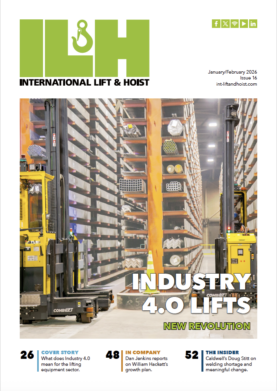
ILH Jan/Feb 2026
In this month's issue