
)
Ride the high gantry
The straddle carrier is a workhorse, while the rubber tyred gantry crane brings versatility to port and terminal operations. But as automation advances, does the gantry crane still have a place in the yard?
RTGs are a mainstay of many container yard operations for good reasons. They bring a level of mobility to container handling that a rail-mounted gantry crane (RMG) simply can’t match. However, as terminals continue to transition to automated cranes, can the RTG keep up?
Significant step
In May, Konecranes unveiled a big step towards full automation, announcing it had finally solved a significant problem – fully automated, unsupervised gantry travel. Designed for mixed-traffic container yards, it is now available both for new Konecranes A-RTGs and as a retrofit for existing fleets.
Konecranes pioneered RTG automation, selling its first A-RTG in 2014. However, until now an A-RTG required safety measures such as a fence around the gantry, or continuous human supervision to supervise the gantry movement.
“From a technology point of view, the industry wasn’t ready for full automation back then,” says Tuomo Korkeaviita, offer manager, RTG Cranes, at Konecranes. “We started looking for solutions in 2019, but it was really difficult to find that technology at the time.”
Thanks to technological advances since, the Finnish OEM’s new solution works with multiple layers of detection: long-range 3D lidars detect large objects up to 50m ahead, enabling early detection and controlled deceleration.
“When the system detects a truck, it calculates the vehicle’s speed and direction of travel. On that basis, it can slow down or even stop as needed.
At close range, a safety-rated laser scanner provides object detection and supports stopping when required. Combined with safety encoder feedback and mechanical protective covers, the system supports reliable gantry travel and helps reduce collision risks.
“We invested a lot of time in testing different sensors and technologies to ensure full detection of objects, says Tuomo. “In this way, we can be sure that the availability of the cranes is not interrupted and automated gantry movements are as reliable as with manual operation. It took us years, but we were successful – trucks can now safely bypass the gantry runway.”
Konecranes sees the tightening labour market for RTG operators as the main driver for investment in automation. It also aids terminal managers in accurately predicting crane availability while improving productivity.
In addition, there are benefits in terms of reduced maintenance costs and longer operational life. “We already see that automation means better handling of the cranes than in manual cranes,” says Tuomo. “An A-RTG can make sophisticated calculations so is slowing down smoothly.”
Proven technology
Konecranes’ automated gantry long travel function is PLd safety-rated according to ISO 13849-1 and has been verified against ISO 3691-4 for driverless industrial vehicles, supporting deployment in highly regulated markets like Europe. “We are the first manufacturer to meet the European standards,” added Tuomo.
Several sites are already running its automated gantry, including three major terminals in Europe. “It is already proven and operational,” adds Tuomo. “We have already sold more than 100 A-RTGs with this feature, which demonstrates the level of market demand.” Around 20 percent of sales are for retrofit kits.
This launch is part of Konecranes’ Path to Port Automation programme, which offers container terminals a comprehensive, step-by-step roadmap to full automation, improving the productivity and safety of their equipment, regardless of the brand, in manageable steps at their own pace. Konecranes sees that any step towards the automation brings benefits with higher productivity, increased safety and overall performance of equipment and operation.
Electrification challenge
Electrification has been a boon overall for automation. “Electrification brings more possibilities for data communication, which is a key requirement for automation,” says Tuomo. He also cites predictability of operational costs like energy as why customers like electric RTGs.
The latest addition to the E-RTG portfolio is E-Hybrid, which combines a grid connection with a battery pack. It says that this solution delivers the benefits of hybrid technology to E-RTGs. One of the big benefits here is that a traditional fully electric RTG requires peak power of at least 400kW – and older sites might not have that amount of juice available. By using the battery as the primary power supply for the crane’s operations, and grid power for charging only, the peak power demand from the grid is reduced to approximately 75kW. Konecranes offers three different battery packs with capacity for two, four, or eight hours of autonomous operation. This also means that one 1MVA substation can power 12-15 RTGs, even if almost all are charging at the same time, offering significant savings on infrastructure costs.
In addition, if the grid is unreliable, with traditional E-RTGs even a short blackout will cause the crane to initiate an emergency stop. By relying on the battery instead of the grid only, Konecranes overcomes this issue. “If you don’t have blackouts causing e-stops, you don’t need teams in a terminal ready to react immediately – for example, to go and check the brakes on every crane,” says Tuomo. This will make maintenance requirements of RTGs more predictable.”
Automation trends
Aside from electrification, automation is still the big topic for ports and terminals. This is according to Mi-Jack Europe, a subsidiary of Mi-Jack Products Inc., which is part of the Lanco Group, and manufactures RTGs in the USA for a global customer base. In 2022 it acquired Yardeye GmbH, a specialist provider of port automation and work zone protection located in Karlsruhe, Germany. Yardeye subsequently became Mi-Jack Europe.
“In Europe, automation is more advanced and is increasingly about safety, not just container management or fleet management,” says Stephan Trauth, managing director of Mi-Jack Europe. “The Mi-Jack portfolio fits perfectly here.”
On greenfield sites, he sees that operators are often moving straight to automated stacking cranes (ASCs). But on brownfield sites with large fleets of manually operated RTGs, Mi-Jack can add value through its suite of solutions including collision avoidance, virtual terminal visualisation, inventory management, and fleet monitoring.
“The RTG journey varies significantly between operators,” says Stephan. “It is not uncommon to find three different generations of RTG operating in the same fleet, all from different manufacturers. This can leave terminal operators managing several different technologies and platforms within the same operation. Mi-Jack’s approach is therefore manufacturer-independent, allowing different RTG types and generations to be integrated into a common automation platform.”
“In the APEC nations I see a significant transition in ports that operate large fleets of RTGs and other manually operated equipment. They are taking their first steps into automation. Africa and India also.
“In these markets we can take a step-by-step approach, by adding high precision GPS technology first to help with fleet management or container management. Once you have the hardware for this installed on your cranes, then we can think about remote operation and remote steering capabilities, plus all the safety benefits.”
Mi-Jack’s goal is not to fully automate RTGs. “It is possible, but there comes a point where it is probably more cost-effective to just invest in an ASC,” says Stephan.”
He also sees significant regional differences in RTG demand. “The US still has a huge need for RTGs and a big appetite,” he says. “Africa, Asia and the Middle East are also major markets because they need the flexibility that RTGs bring to their operations.”
“In Europe, RTGs are not a major part of the product mix in large terminals. They are more useful still in small and mid-sized ports that require flexibility. Those facilities are using more straddle carriers, while the big ports are moving toward ASCs.”
Beyond GPS
As Stephan points out, GPS systems for RTGs are no longer a differentiator – everyone has them. “The hardware is not unique,” he says. “You differentiate through the package of solutions you can deliver from that hardware. There are suppliers that can give you a standard solution at a lower cost. But our customisable solutions offer another level of intelligence.”
A lot of the time, this is a learning process for the terminal operator. “I always say, if the customer had the same level of knowledge and understanding at the start of the project as they do at the end, the early-stage conversations would be a lot easier! It is our job to guide them through that process and to build trust.”
The customer journey starts with an operational challenge. “Typically, the customer is not coming to us asking for a specific technology,” says Stephan. “They are coming to us with a problem, and we solve it for them.
“The step-by-step approach of adopting more Mi-Jack solutions reduces the complexity at the beginning. Projects can become more complex when the customer is ready.
Safety benefits
When it comes to safety, the technology can help prevent collisions whether the machine is manually operated or semi-automated. “You can have operator assistance which warns the driver, or you can have a system designed to keep people away from automated machines,” says Stephan.
“In areas where there is a high interaction between people and equipment, this is where safety becomes the most important.” The aim here is for the technology to help maximise equipment operation time without increasing risk of a collision with a human.
Next generation
In terms of the technologies that support RTGs, incremental change is coming. “The new GPS hardware can offer you more diagnostics capabilities and even higher precision,” says Stephan. “That means a new generation of software platforms are coming.”
In addition, the hardware continues to change. “Minimisation is the big topic here – smaller hardware at a lower cost,” says Stephan. And cybersecurity is a key trend as manufacturers move to comply with the EU’s cyber resilience legislation.
“In Europe, the RTG is still a great product for mid-sized terminals that need the kind of flexibility this machine brings. But we do think the product mix will change even more in the future, and it will be interesting to see where the story of the RTG goes next.”
Training focus
Advances in technology are also changing the way operators are trained on RTGs – and how that training can be delivered.
CM Labs Simulations offers simulator-based training via its Intellia curriculum. This is designed to give operators a realistic learning environment, without the risks inherent to letting a trainee operate real equipment.
The exercises are progressive, so trainees can start with basic controls and familiarisation, then work their way up to more challenging container-handling scenarios. As they progress, the develop better control precision, spatial and situational awareness, load handling, and decision-making. Instructors can also make the training more challenging by changing weather or visibility, introducing traffic or other unexpected situations, and creating different equipment faults.
“Because the RTG and its systems are modelled in a high level of detail, we have quite a bit of control over the kinds of failures or abnormal conditions that can be introduced, which lets instructors see how trainees react when something doesn’t go according to plan,” says Devon Van de Kletersteeg, ports and industrial product growth manager for CM Labs Solutions. “It’s much better to encounter those situations for the first time in a simulator than on a live RTG.”
While instructors can create different scenarios and operating conditions, the company can also adapt its training to a port or terminal’s specific operations. “No two terminals are exactly the same,” adds Devon. “So, while we have a strong baseline curriculum, we’ve also built the system with the ability to support more site-specific training needs.”
Appetite for in-cab operator training remains strong, while demand for remote operator training is growing. “Different ports are taking different approaches, and there are still many terminals where conventional in-cab operation makes perfect sense, so our goal is really to support both,” says Devon.
For remote RTG operation, operators can train using camera-based views, realistic remote controls and workflows, and different levels of automation depending on how the terminal operates. “That flexibility is important because there isn’t really one standard model for remote operation,” he adds. “Different terminals use different equipment, automation strategies and operating processes, so we’ve designed the solution to provide a strong baseline while also being adaptable to the needs of individual customers.
“One of the big differences with remote operation is that operators no longer have all of the physical cues they would normally get from being in the cab. They’re relying much more heavily on cameras and visual information, so simulation is a really useful way to build that situational awareness and get comfortable with the remote operating environment before working with live equipment.”
Bespoke benefits
Austrian OEM Künz is also pushing the capabilities of automated RTG cranes. It recently signed a contract with Flinders Port Holdings (FPH) to deliver a cantilever ARTG in Australia. This is destined for the GatewaySA programme of works, totalling more than $300 million of investment at Flinders Adelaide Container Terminal (FACT).
This new model combines the advantages of automated handling for both trucks and stacking areas with the proven side-loading concept that is widely used in most RTG port terminals.
The cantilever design separates the truck and the container stacking area and eliminates any potential truck and crane interaction. The truck handover area is beneath the crane cantilever, while the stacking area is positioned between the posts, eliminating the need for trucks to cross the crane traveling beam. This design significantly increases safety for both personnel and machinery.
“The delivery of the first cantilever RTG crane for the Australian market is of great significance to us,” says David Moosbrugger, managing director of Künz. “We are convinced that our concept and its associated benefits are specifically tailored to the requirements of the Australian and other port markets. At the same time, this project marks the successful entry of Künz into Australian port operations.”
The acquisition of this custom designed crane is a culmination of over a year of collaboration between the GatewaySA and Künz teams. The new ARTG is tailored to meet the specific requirements of FACT, with Künz saying it will deliver workplace health and safety and operational benefits that surpass existing market solutions.
The first machine aims to establish proof of concept for FPH, and could potentially lead to a change in operating mode away from manual straddle carriers at FACT. A designated ARTG block and testing area will be established to performance test and evaluate the cantilever crane, ancillary and safety systems.
Upon successful completion of testing, FPH will be equipped to make informed decisions regarding the future operating mode at FACT, potentially setting a new standard in container terminal operations globally.
“The signing of this contract brings us another step closer to future proofing FACT, while supporting the needs of our customers and the South Australian economy well into the future,” says FPH CEO Stewart Lammin.
Commissioning is scheduled for June 2027, with the trial due to run until the end of the year.
Yard versatility
Straddle carriers fulfil a slightly different role to RTGs, but it is still a vital one.
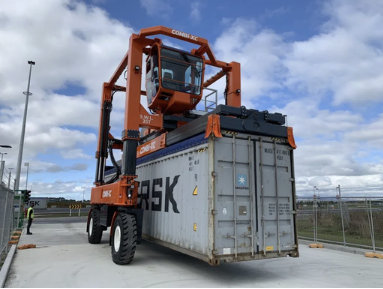
The Combilift Xpress Carrier is specifically designed for the quick movement and transport of containers over long distances, in typical container terminals and ports. It has the added advantage of speedy operation, shuttling containers at high-speed up to 25km/h fully laden. It can lift 20ft, 40ft and 45ft containers with its auto top-lift spreader, which side-shifts left and right to allow easy lifting and accurate placement of containers.
“It is particularly suited to container logistics environments where containers need to be moved frequently, safely and efficiently over extended distances,” says Combilift. “Its main advantage is that it streamlines logistics operations by combining fast travel speeds, excellent stability and efficient container handling into a single, highly productive machine.”
In a crowded market, differentiation is key. Combilift designed the Combi-Xpress Carrier with a low centre of gravity for added stability while manoeuvring heavy loads. The ergonomic cabin is mounted above the load, giving operators 360-degree visibility and enhancing safety and control during operation. The cabin is also designed with operator comfort in mind, providing an ergonomic working environment for those working long shifts.
“High travel speeds and a tight turning circle enable the Combi-Xpress Carrier to manoeuvre efficiently, even where space is restricted,” says a company spokesperson. “Its central load-carrying configuration ensures optimum weight distribution and contributes to efficient handling.”
Features include large, puncture-proof flotation tyres. When combined with a low unladen weight this significantly reduces ground pressure. This enables the Combi-Xpress Carrier to operate effectively on poor or semi-rough terrain without the need for costly ground resurfacing or improvements. Its lighter weight and efficient design also contribute to reduced power consumption and lower operating costs
“The Combi-Xpress Carrier is an excellent alternative to typical port SCs and/or shunt trucks for moving containers from the ship-to-shore crane to the stacks, as it eliminates the loading/off-loading time of shunt trucks by giving the operator the freedom to lift the container and move it directly to the stacks,” says the spokesperson. “By eliminating the need for terminal tractors, it simplifies logistics and streamlines transport processes.”
Doubling down
More recently Combilift launched a two-high version is available, enabling containers to be safely stacked one on top of another. “A key factor in our success is our commitment to continuous innovation and a customer-focused approach, developing solutions that respond to the evolving needs of our customers,” the company says.
So far it has produced two units of its 2-High Shuttle Express Straddle Carriers, which it says marks a significant milestone in the development of high-speed container handling solutions. Both were destined for port operations in Honduras, Latin America.

ILH free trial
Click here to get your free copy of ILH magazine and the bi-weekly e-Newsletter
New Issue
ILH October 2026
In this month's issue