
)
Big, hairy goals
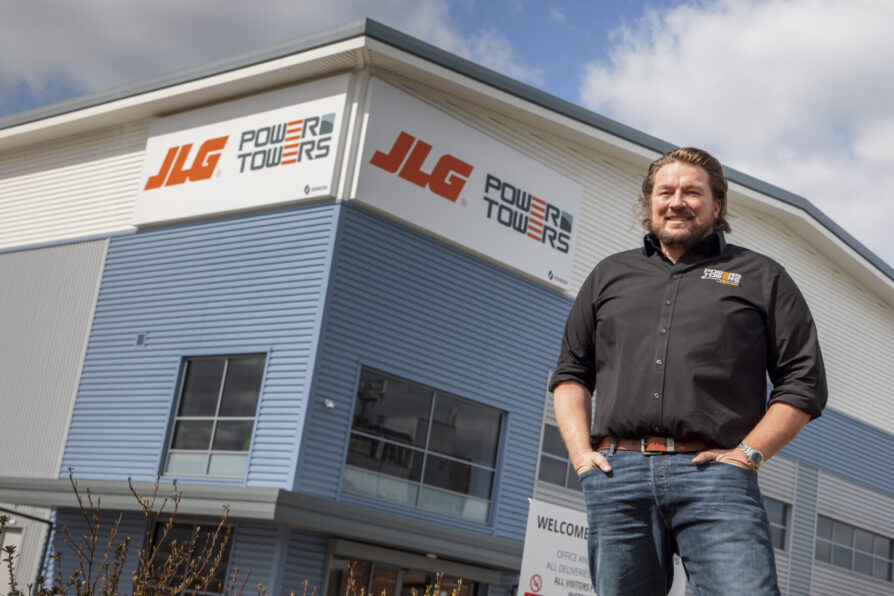
JLG has just promoted Jonathan Dawson to vice-president of its international region. ILH caught up with him to discover how he plans to tackle this exciting new challenge.
You celebrated 20 years with JLG in March 2006. How has the company changed during that time? And what has kept you at the company for so long – what do you love about it?
JLG has undergone many changes since I joined the company in 2006 – as you would expect. It’s not possible to stand still in a market that has changed substantially as well over the same period.
The one thing that has been consistent throughout the last 20 years is that JLG adapts and innovates to stay at the forefront of the market. For example, JLG was acquired by Oshkosh Corporation in 2006, not long after I joined the company. And in 2009-2010, during the financial crisis, JLG leveraged that relationship to keep the factories running by building military vehicles for Oshkosh, enabling us to retain talent and maintain efficiency in our key plants. Since then, we have seen many changes in the market, from the commoditisation of products to the exponential growth in market competition.
Through it all, JLG has had to adapt. As the founders of the industry and with a customer base that relies on JLG products to get work done, we continue to innovate in every way we can, both in products and services, to keep the value in our products, and therefore also in the broader market.
The global access business needs stability, and JLG provides that. To be successful in today’s markets, OEMs must also be adaptable, and that is what JLG has been, time and again, since I joined the company 20 years ago.
On a personal note, being a part of this journey has been great, working with remarkable people and enjoying the industry – and the company is what makes the time pass quickly!
What has been the biggest achievement in your career to date, and the biggest challenge?
I’ve been very fortunate to be part of this great company for the last 20 years. I’ve had many different roles and responsibilities in that time, from sales to operations to service and marketing, and also as the general manager of a business unit. The one constant has been the talented people I get to work with, worldwide, within JLG and Oshkosh.
It’s not a product or service that makes a business great, but the people who get up and go out to win for the business every day. The team at JLG has a passion for what they do, and that stems from a culture of belief and alignment with what the business wants to achieve. We all believe in making the world a safe place for everyday heroes who build, clean, maintain or repair things working at height. I consider it an honour and achievement to have been a part of that for 20 years.
In terms of challenge, every time a role changes, it is a challenge – if it’s not, then you’re not pushing yourself, your team, or your ambition in the role hard enough. It’s important, no matter how much you think you know, to always push and feel challenged. Of course, that is then coupled with whatever challenges the market throws at you, and there’s often plenty of those as well. We set ambitious, aspirational goals, and sometimes things just don’t work out for whatever reason – but I think JLG is great at being resilient. I often say to the team not to let perfection get in the way of progress. Even if we fail to meet our BHGs (Big Hairy Goals), something will always get better by trying.
How are you settling into your new role? And what is it that excites you most about this role?
I’ve spent the early part of this year listening and learning about the key challenges and differences in the ‘International Region’. Whilst many of the same challenges are present globally, there are always regional nuances.
The world has changed a lot over recent years because of tariffs. The main ones are those imposed on equipment of Chinese origin entering the EU and the US, which has an impact in many ways. All JLG wants is a level playing field. We have the responsibility to be a stable and consistent presence in the industry, so the implementation of tariffs doesn’t change our behaviour.
We have a responsibility to our people and our customers to be successful and competitive, despite the market conditions in any given region. So, we have localized manufacturing of as many products as we can – it’s been a busy year for our operations teams everywhere.
The flip side of the effective barriers to entry into Europe and the US, coupled with a softening in the Chinese domestic market, has OEMs now looking to sell into a much smaller market in the International region. That makes it one of the most competitive regions globally today.
The region presents great opportunities, and a very diverse set of requirements from one place to another – what a customer wants in Japan is different from Korea, which is different from China, and so on. We aim to be a manufacturer that can provide solutions for the job at hand in each market. This requires flexibility and adaptability. For JLG, this is great news because we have regional teams with regional autonomy to support local customers, enabling us to meet regional needs.
For me, what makes this role exciting is the ability to set up, and support, JLG’s business for local success.
In the press release announcing your appointment, JLG’s president, Mahesh Narang, described you as someone capable of “driving growth, navigating complex markets and building high-performing teams”. How will those skill sets help you in your new role?
I’m fortunate enough to have inherited a high-performing team in a complex market. But I also gained an understanding of market dynamics after 20 years at the company. So, I have spent some time analysing the markets over the last few months, and if you look at historic sales levels in this region, most countries are relatively normalised now.
However, China saw exponential growth from 2021-2024, post-Covid. Our estimate is that the market grew in that period to a volume equivalent to 11 years’ worth of supply in the space of four years, which suggests there are several years of excess supply in the market. This coincided with the growth of the Chinese OEMs, and nearly all of this supply came from them. This was also the period that saw the transition from diesel to electric boom lifts in China. This has created a major challenge in the region’s largest market: too much obsolete fleet sitting in rental yards and too much product to easily exit.
My belief is we need to go through an ownership cycle to understand the true cost of this oversupply, so the big question is: what will be the global effect on the value of these brands of equipment? I think over the next 5-6 years, we will see a shift in the market.
For JLG, I foresee the localisation of both our products and our ability to support the customers in terms of jobs to be done, flexing and adapting to the market requirements. We are also in the process of setting up a new master Parts Distribution Centre (PDC) to support the region – this will give faster parts supply, allow local sourcing, and therefore, cost-competitive pricing for our customers in the region.
We are also setting up a Reset centre to support trade-ins of JLG equipment, whilst providing quality used equipment with a manufacturer’s warranty for resale to markets that prefer used equipment.
We continue to lean into the capabilities of JLG’s ClearSky Smart Fleet IoT (Internet of Things) system to demonstrate the value of investing in JLG throughout the equipment’s lifecycle. Our mission is to help customers realize that the total cost of ownership of JLG equipment can offer long-term value beyond initial purchase price.
It’s a newly created role; what have you achieved in your first 100 days?
I’ve travelled through the region, meeting teams and customers, and have booked my next trip to see more. I have been very focused on getting to know the team, understanding the challenges, and working together to either continue or build new strategies to ensure we are successful and that JLG remains the supplier of choice. There’s lots to do, but we are heading in the right direction.
You’ve been tasked with developing an amazing but very diverse regional portfolio – Australia, New Zealand, Asia, India and the Middle East. In which regions is JLG most established and also where are the biggest growth opportunities?
I don’t think we’ll see any markets display exceptional growth in the short term. Markets like India, though, could have huge potential in the future but aren’t quite there yet. We are getting ready. In March, we will produce our first scissor lifts in India out of a new factory, and we are growing both our people presence and our supply chain in the Indian market in preparation for the future.
We will continue to focus on working with customers throughout the region, helping them to understand the value in owning a JLG product and partnering with us. If we do our job correctly, as we move through the ownership cycle, the strategies we implement to support the product throughout its life and into second ownership will help us grow our share in the various markets within this region.
At least three of those regions – Asia, India, Middle East – are being aggressively targeted by Chinese OEMs. How do western OEMs like JLG compete?
Looking holistically, all of the regions are being targeted by Chinese OEMs; it’s a dynamic that JLG teams everywhere are having to deal with.
JLG founded this industry in 1969 and has been a stable, reputable player throughout the subsequent 57 years, and we will continue to be – not by competing on price alone but by leading with innovation and value throughout the lifecycle of our products. Whether that be a LiftPod or an Ultra boom lift, and all the ecosystems around the products, when our customers buy a JLG, they become part of the JLG family. We differentiate ourselves by providing the strong partnership and service throughout the total ownership cycle. We believe customers who value this will continue to choose JLG, no matter how aggressively other players target them.

ILH free trial
Click here to get your free copy of ILH magazine and the bi-weekly e-Newsletter
New Issue
ILH September 2026
In this month's issue