
)
Synchronised lift for historic windmill
Enerpac heavy lifting technology, deployed by Bresser, a Dutch contractor specialising in foundation remediation, jacking and relocating, has played a key role in raising a 250 year-old historic hexagonal tower windmill as part of flood protection measures. Weighing 280t, the Waardenburg windmill was raised 800mm onto 18 new foundation piles using a network of Enerpac cylinders operated synchronously with an Enerpac EVO system.
Located near Waardenburg Castle in the Dutch municipality of West Betuwe, the 14m high structure is a rare hexagonal mill, one of only a few remaining in the Netherlands operating to this day as a functional grain mill. The need to raise the mill arose from a dyke reinforcement project along the nearby River Waal, commissioned by Waterschap Rivierenland, the regional Dutch water authority, and executed by the Mekante Diek construction consortium. While raising the dyke enhanced flood safety for local residents and businesses, the increased height of the dyke threatened to block wind flow to the mill’s sails.
Synchronised precision lift
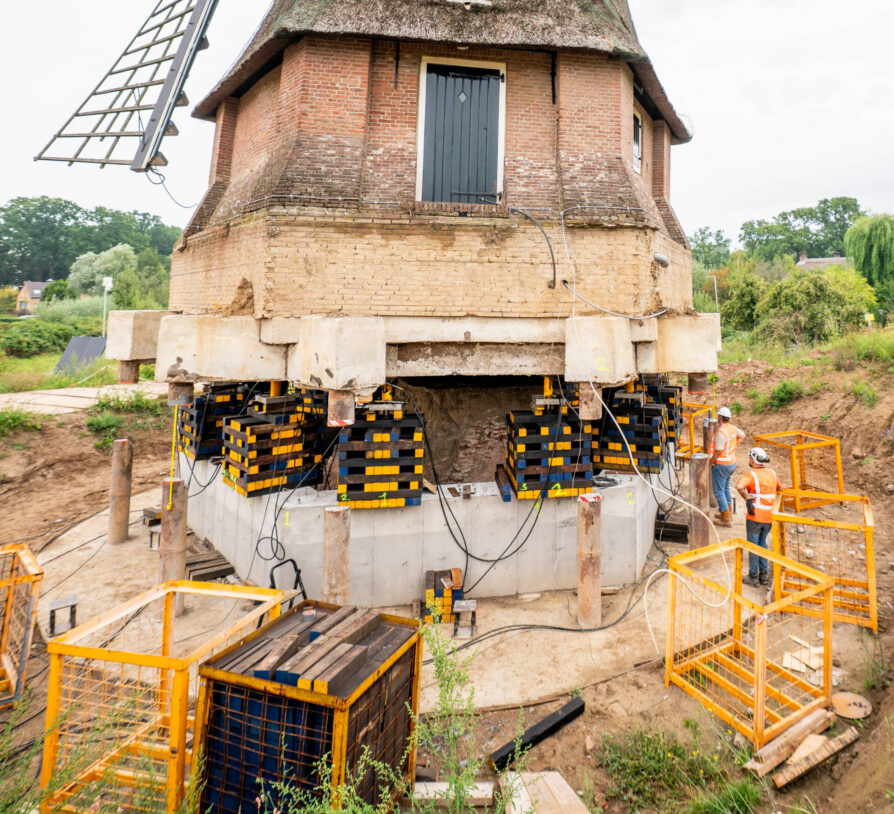
To execute the precision lift without compromising the integrity of the 18th-century masonry, Bresser specialists first excavated the soil 1.6m beneath the mill to reveal the mill’s existing concrete platform and supporting piers installed in the 1990s. 18 new foundation piles were installed around which a new reinforced concrete ring beam was poured to distribute the forces from the mill evenly. To jack-up the windmill, Bresser used a climbing jack method involving 12 double acting, 50t capacity Enerpac cylinders positioned on the reinforced concrete ring beam and controlled by an Enerpac EVO system to provide synchronised lifting and load management.
Maintaining mill’s tilt
An additional benefit of using the Enerpac EVO system was the ability to maintain the mill’s pre-existing minor tilt throughout the process. Precise, synchronous cylinder stroke control ensured the windmill remained at its exact original angle, preventing structural stress and disruption to the mill’s internal machinery.
The 800mm lift was executed at a rate of approximately 100mm per hour. Once the desired height had been achieved, 18 steel pile sections were inserted between the lower concrete beam and the windmill’s concrete platform. Once the permanent structure had been completed, the cylinders were removed and the space beneath the windmill backfilled.
“Lifting a 250 year-old national monument as part of major civil flood protection works requires absolute control and reliability,” said Taco Bresser, managing director of Bresser. “Our experience with Enerpac hydraulic cylinder jacking systems, and EVO synchronised load management and lifting, meant we were able to confidently proceed with the project, even taking into account the windmill’s slight tilt.”
The windmill now stands 800mm higher than before, enabling it to once again harness the wind and continue operating as a working grain mill.

ILH free trial
Click here to get your free copy of ILH magazine and the bi-weekly e-Newsletter
New Issue
ILH September 2026
In this month's issue