
)
Clean, green energy uptake drives surge in specialist lifting machinery
As the move to clean, green electrical energy accelerates to meet Australia’s 2030 emissions deadlines, huge quantities of heavy new electrical plant will need to be safely and delicately lifted, shifted and positioned within confined places.
New turbines, generators, transformers, switchboards, charging infrastructure, batteries, and emergency backup plant – some of which weighing 50-100 tons or more – will be needed at transport and logistics facilities, industrial and social infrastructure construction projects, factories, food and beverage process plants, warehouses, and mining, gas and energy projects.
“Australia faces a huge increase in new electrical plant capacity over the next decade, with the Australian Energy Market Operator (AEMO) forecasting a near tripling of total generation and storage capacity by 2035 to reach 190 gigawatts (GW), up from 82 GW currently,” says Australian actuation, isolation and suspension specialist Air Springs Supply.
“This massive expansion of new energy inputs is driven by the retirement of coal-fired power stations (90% expected to close by 2035), increasing electricity demand from electrification of transport and industry, and the national target of 82% renewable energy by 2030,” says Air Springs Supply technical product manager, Vinh Lam.
The boost in electrical energy generation will in turn lead to a surge in demand for new plant and infrastructure across industrial and commercial developments, both in space-efficient new development and repurposing of limited space within existing facilities. Preparing for heavy lifts involved inside factories, workshops, and materials processing plants can pose accessibility and safety challenge in confined spaces, especially where overhead cranes are impractical.
Big new items of electrical machinery and plant can easily weigh 10-20t or more and sometimes 10 times that, says Vinh. Such large and valuable machines need to be kept balanced, level, and secure while being lifted to create space beneath the load for the insertion of transport pads, load skates, and specialised materials handling equipment required for lifting, shifting, and dispatch.
One portable and swiftly deployed solution to this need is provided by Pronal CLT lifting cushions from Air Springs Supply, which is the Australian distributor of the broad international range of low and high-pressure Pronal lifters.
Compact, low-profile CLT lifting cushions – ranging from individual capacities of one to 65t, with heights of 90 – 515mm – can be used separately or in multiples for safe, evenly distributed lifting in confined spaces inside, or on softer surfaces outside.
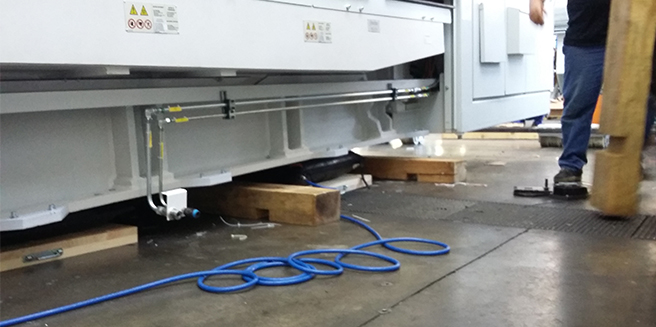
Their capability was recently demonstrated by a manufacturer which used CLT cushions to raise a 25t machine for delivery – providing a stable and controlled lift where space was limited.
Because the manufacturer’s crane previously handling such tasks had a 20t limit, the manufacturer needed to find a practical and safe lifting technique by which the machine could be lifted 85mm above the 100mm clearance height existing between the floor and machine chassis.
Four CLT43 lifting cushions, each with a lifting capacity of 43t, were positioned under the machinery for an even lift, each connected by 10m hoses through two deadman controllers with two outlets and incorporating safety switches that deactivate equipment if the human operator becomes incapacitated.
“This flexible lifting system, simple and practical to implement, allowed the client to smoothly lift the machines to the required height with compressed air,” said Vinh Lam.
CLT cushions operate with a working pressure of 8bar (116psi), typically provided by standard workshop compressors. The CLT 43 models used in this case have an air capacity of 646 litres and a lifting capacity margin far in excess of the weight being handled. CLT lifting cushions also feature a burst capacity four times their rated lifting capacity, giving high safety margins.
“In addition, the cushions were controlled remotely by a mobile control unit. This essential device provided the necessary security for its operators when handling the machines,” said Vinh.
For further safety, pneumatic lifting cushions have larger ground and load contact areas (rather than point loads) which means they can be safer, more stable and more effective to use in softer outdoor conditions.
CLT lifting cushions are engineered for robust performance, being constructed with aramid fabric reinforcement coated with elastomer, hot vulcanised in an autoclave. They are designed to provide a higher lifting capacity than conventional high-pressure (8 bar) lifting cushions.
The interlocking surfaces of each cushion provide strong gripping when cushions are stacked for higher lifting strokes. They meet or exceed all standards for lifting cushions and are compatible with conventional inflation control systems.
Their thin profiles and low weights (0.6 – 22kg for 1 – 65t CLT cushions) also make them suitable for multipurpose, repeat, and mobile applications, such as being suitable for vehicle recovery, quarry rock splitting, pipeline lifting, shifting, and positioning, and emergency or rescue services.

New Issue
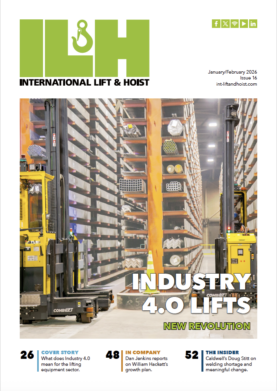
ILH Jan/Feb 2026
In this month's issue