
)
Stabau’s multi-pallet forks boost efficiency
Rising handling volumes, tighter supply chain schedules and increasing cost pressures are presenting new challenges for companies in the intralogistics sector. Any company wishing to remain competitive today must consistently optimise its processes for efficiency. The ability to transport several pallets at once offers a key advantage in this regard. With the S7 series multi-pallet forks, Stabau offers a solution that addresses precisely this need and delivers a measurable increase in productivity.
The multi-pallet handler enables several pallets to be picked up simultaneously. Compared with conventional single-pallet handling, this significantly reduces the number of trips required and saving time.
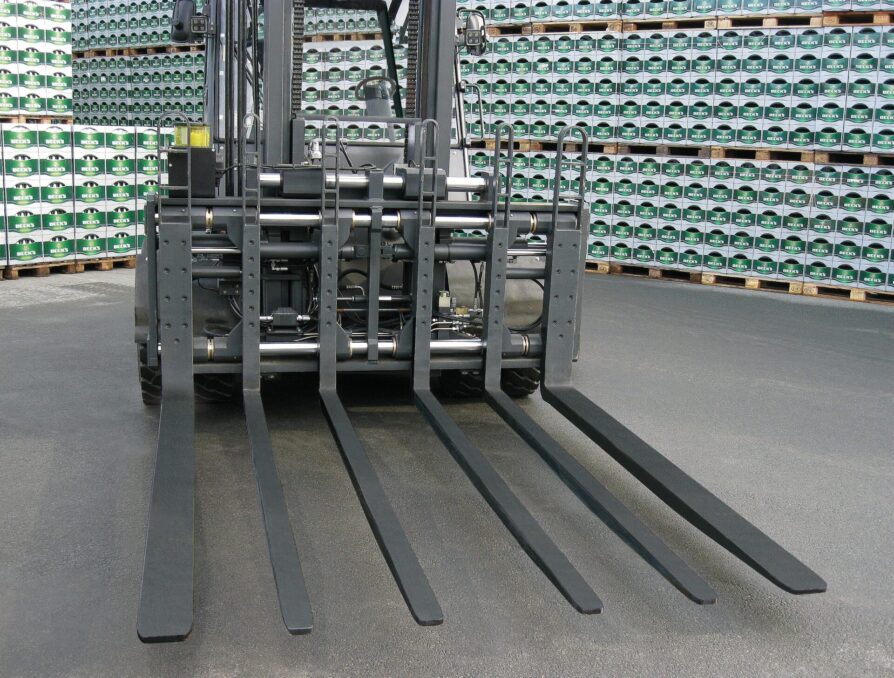
Depending on the model, the attachment can handle one, two or three pallets side by side, or – with the appropriate fork length – up to eight pallets in a combination of front-to-back and side-by-side configurations. The S7 multi-pallet handler covers a wide range of applications, particularly in sectors with high goods throughput such as the drinks and food industries or building materials logistics.
The S7 multi-pallet handler is available in various designs and, depending on the machine type, offers clearly defined load capacities for different intralogistics applications.
The double pallet handler (DPK) allows one or two pallets to be handled side by side or, with the appropriate fork length, two or four pallets in a row.
The triple pallet handler (3-PK) extends this principle, allowing one, two or three pallets to be handled side by side in a single operation.
For applications with particularly high throughput volumes, Stabau offers further high-performance solutions: the SPG is designed to handle four or six pallets, whilst the APG enables the transport of six or eight pallets simultaneously.
The product range thus covers a broad spectrum of capabilities, from flexible solutions for variable operational requirements to equipment designed for maximum handling capacity in a single lift. This enables companies to optimise their logistics processes in a targeted manner and significantly increase the efficiency of their industrial trucks.
Standard solutions often reach their limits, particularly in confined storage and logistics areas. For such requirements, Stabau offers specially adapted versions of the double-pallet handler.
For example, models with telescopic fork tines enable lorries to be loaded and unloaded from one side. Pallets can be pushed precisely to the rear of the loading area or picked up from there. This reduces manoeuvring effort and saves valuable time, particularly where space is limited.
Alternatively, variants with a feed fork carriage are used. These allow pallets to be placed or picked up precisely in the rear rows when the use of long or telescopic forks is not possible.
A key advantage of the Stabau solution lies in its flexibility. The double-pallet handler features two pairs of forks, the spacing between which can be adjusted hydraulically. This allows different pallet sizes and operating scenarios to be handled quickly and precisely without the need to change equipment.
As standard, the units are equipped, amongst other things, with a separate side shift, which offers additional manoeuvrability when positioning the load. This is complemented by bolted-on fork tines and a patented synchronisation system that enables the forks to move in unison without the need for additional valve control.
The result is high working speed combined with precise handling, even under demanding operating conditions.
As well as functionality, the design also plays a key role in day-to-day performance. For the S7 series, Stabau relies on low-wear, easy-to-install guide systems and a robust construction designed for continuous industrial use. Further practical features, such as raised outer forks to stabilise the load or excellent visibility for the driver, help to enhance both safety and efficiency in equal measure.
Various optional extras are also available, such as mechanically or hydraulically folding load stops to adjust the usable length, or additional load restraints to stabilise delicate or unstable goods.
ILH free trial
Click here to get your free copy of ILH magazine and the bi-weekly e-Newsletter
New Issue
ILH September 2026
In this month's issue