
)
Manufacturing goals
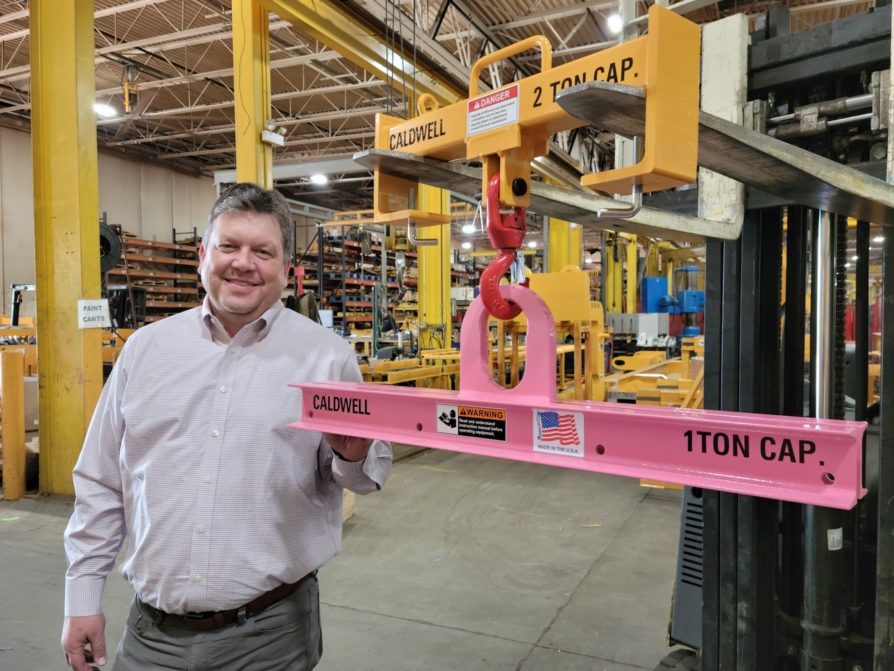
The sports sector has long understood something industry is only recently leaning into, in that recruitment is not just a process, it is a public-facing brand moment. That’s not the only thing we can learn from the world of sport, says Doug Stitt, president and CEO at The Caldwell Group Inc.
We should pay more attention to an industry that scores points and achieves goals for a living. In sport, success is a non-negotiable tagline to every function; something my beloved Chicago Bears know better than most, where every drive is measured in yards gained, every play is judged on execution, and every season ultimately comes down to whether the team delivered when it mattered most.
In May, we attend the Stateline Manufacturing Alliance Signing Day at Blackhawk Technical College in Janesville, Wisconsin along with two High School seniors, formally committing to begin their careers in skilled manufacturing at our company. These signees are among those have spent time working with industry part-time while completing school and have chosen to continue with those organisations after graduation. The event recognises both the students’ commitment to the manufacturing trades and the local employers investing in the next generation of skilled talent.
As the big day approaches, and I work with Amy Garris, who oversees education outreach, to finalise plans to ceremonially welcome these individuals to the company, I am continually reminded how central recruitment remains to our long-term strength and identity. It is equally apparent how short of the mark many approaches still fall, failing to connect meaningfully with the very people they are trying to reach, or to convert genuine interest into lasting opportunity. Among the reoccurring problems is that recruitment is often viewed simply as a function to fill roles, when really it is much more about marking the moment people choose to join a company, recognising their potential, and signalling to the wider industry that a business invests in talent from the very beginning of their journey.
The sports sector has traditionally done a much better job of this than industry, as demonstrated by the US tradition of National Signing Day. In American college sports, it is not simply an administrative deadline for accepting scholarships. It is staged as a media-friendly event where athletes commit to their future in front of peers, coaches, press, and increasingly, social media audiences. The message is clear, that this is an achievement, a commitment, and a signal of ambition for both the athlete and the institution.
Manufacturing recruitment is often the opposite; it is quiet, transactional, and hidden behind job boards or internal human resources systems. Yet the sector is facing acute skills shortages, ageing workforces, and intensifying competition for technical talent. That makes visibility and perception just as important as pay and conditions.
From sports, manufacturing can borrow the idea that recruitment is storytelling. There is also a cultural lesson. Sports organisations invest heavily in making talent feel chosen, valued, and part of something larger than a job description. That sense of belonging is a powerful retention tool, particularly in sectors like manufacturing where long-term skills development matters.
Welding connections
Manufacturers must increasingly set clear goals to help fuel pipelines of welders and other workers by reaching students who already have an interest in and talent for trades, but who may not yet see a direct or accessible route into industry.
These strategies should revolve around engagement at the right depth, at the right stage, ensuring that genuine capability is not lost through poor visibility or weak signalling from employers. By connecting earlier and more meaningfully, it is possible to convert existing interest into structured pathways, sustained development, and ultimately long-term careers in manufacturing.
It is easy to assume that challenges such as welder shortages are purely the result of a lack of interest in manufacturing careers, but that can be a misleading simplification. In reality, there is often genuine appetite to enter the sector, yet that interest is not always effectively converted into applications or long-term engagement. The issue is frequently less about inclination and more about how well the industry communicates opportunity and reaches its intended audience. Recruitment campaigns, therefore, cannot rely on surface-level messaging or polished branding alone; they need to be meaningful, targeted, and deeply penetrative, cutting through perception gaps and speaking directly to the realities, aspirations, and motivations of potential entrants.
One of my company’s aforementioned recruits is a case study in the power of aligning the moving parts. We heard him on the radio discussing his welding skills and went looking for him in-person, even as he too sought an industrial doorway to push his welding-gloved hand against. This route into industry underscores a bigger point, that capability often exists in plain sight, but requires more proactive, human, and sometimes unconventional approaches to identify, engage, and connect it to opportunity.
More broadly, I see great recruitment and awareness campaigns fail because these important final steps weren’t taken when the more exhausting build-up play had already taken place. Too often, attention is successfully created and interest is genuinely sparked, but the momentum is then lost at the point where it needs to be converted into action, whether that is a conversation, an application, or a clear pathway into the business.
In effect, the groundwork is done, but the finishing is missing. In sporting terms, it is the equivalent of building the play perfectly, moving the ball through the lines, creating the space, beating the defence, only to miss the final pass or shot on goal. The result is a disconnect between visibility and outcome, where strong messaging fails to translate into tangible talent pipelines because the final, human steps of follow-up, engagement, and removal of friction are not given the same level of care or urgency as the initial campaign itself.
Spinning a web
It is regrettable, because it is in these final, winning moments, and after them, that the greatest joy is often experienced (see insert, ‘Winning mentality’). One of the reasons we’re so passionate about sharing our welding recruitment programme is because of how uplifting the journey is proving for everyone involved; it is like being part of a championship-winning sports team.
Amy, as coach, will tell you how hugely satisfying it is when a young person describes their work and says, “I get to” rather than “I need to”. That subtle shift in language reflects a powerful pivot in mindset. It reframes work or learning from obligation to opportunity, which is exactly the kind of attitude industries want to foster in early talent. In a manufacturing context, it is the difference between someone feeling they have to complete a task and someone recognising they get to develop a skill, contribute to something tangible, and build a career. Embedding that mindset can be a subtle but important way of improving both motivation and long-term retention.
The education sector appreciates meaningful industry contact too; we’ve been welcomed with open arms at every juncture. They check in to visit graduates, and we give our time generously in return, even to endeavours that don’t immediately impact our company. It is a partnership built less on transactional exchange and more on long-term investment in people; an understanding that the strength of the funnel depends on sustained, real-world connection long before anyone steps onto a shop floor.
When Beloit Memorial High School’s welding instructor, Joe Kluge, recently reached out for support, we were ready to jump in. While volunteering his time to lead an after-school introduction to welding programme for middle school students, he needed help cutting 18 spider parts — yes, spider parts — from steel for a hands-on class project.
What does your recruitment web look like?

ILH free trial
Click here to get your free copy of ILH magazine and the bi-weekly e-Newsletter
New Issue
ILH September 2026
In this month's issue