
)
Ergonomics in action
Humans are not weak links, but modern systems are too often built without them in mind. The lessons should have been learnt in the not-so-distant past, says Steve Napieralski, president at Oz Lifting Products.
Those of us who have been working for long enough will remember a time when we first started to factor in the impact of work and production on the human being. Before that shift, productivity and output often dominated the conversation. Efficiency was measured in units per hour, not in long-term health, sustainability, or cognitive load.
Gradually, ergonomics moved from the margins to the mainstream. We began to redesign workstations, introduce mechanical assistance for heavy lifts, and reconsider repetitive tasks that quietly wore people down. The recognition was simple but powerful: if you design work around people, performance improves.
Ergonomics may have once been a fashionable buzzword, but too often today it is overlooked; in some industries, it feels almost forgotten. That’s a mistake. Its definition remains as relevant today as ever: the science of designing work, tools, and environments to fit people, rather than forcing people to fit them. Done well, ergonomics improves safety, comfort, and efficiency, while reducing both physical and cognitive strain. These benefits are timeless, not trendy.
We must be careful that, even as manufacturing, robotics and artificial intelligence (AI) advance, we don’t lose sight of the progress we have made in making the workplace safer and more bearable for people. It remains true that people still design robots, programme them, supervise them, maintain them, and work alongside them. Why create a world that doesn’t place human beings at its heart, when we’ve worked so hard over many decades to improve best practices with longevity and quality of life in mind?
Robots have no skeletons to strain, no muscles to fatigue, no emotions, and no families waiting at home. Yet, in some discussions about continuous improvement, automation and hardware are treated as the centrepieces; they are the benchmarks for efficiency. The danger is clear: optimising around machines alone risks creating workflows that maximise throughput but overlook the human cost, as we might have done a century ago. True best practice isn’t just about speed or cycle times; it’s about sustainable performance that people can maintain safely and effectively.
Even in highly automated environments, humans remain the decision-makers, supervisors, and problem-solvers. When my company’s research, development and engineering teams are thinking about our next innovation, the goal is not to elevate machines above the workforce, but to design systems where humans and their tools work in harmony. It’s the execution plan that underpins our seven U.S. Patents. Machines can run endlessly; people cannot. Best practice must orbit the human, not the hardware.
Skeleton staff
I was reminded of the importance of this human-centred approach only last month (February) when I was having one of a number of conversations about eliminating musculoskeletal strain during the AHR Expo, which attracts a delegation of heating, ventilation, air-conditioning, and refrigeration (HVACR) professionals. Many people we spoke with talked about work-related injuries they encountered in their careers; and these stories weren’t just coming from those approaching retirement. We also had dialogue about growing regulatory and insurer pressure to demonstrate proactive manual handling risk reduction.
As I’ve said before, trade shows are a unique window into the priorities and habits of professionals. Unlike surveys or online engagement, they allow you to see and measure behaviour in real time: which booths attendees stop at, which products they pick up, and which demonstrations hold their attention. These actions reveal what truly matters to them. The combination of verbal cues, body language, and physical interaction creates an immediate feedback loop for understanding mindset and intent.
As AHR attendees demonstrated, the spotlight on human risk must be retained, while regulators and insurers demand demonstrable mitigation for their own purposes. Portable material handling solutions, davit cranes, and other lifting aids are no longer optional extras; they are integral to meeting compliance and protecting workers. But technology alone is not enough. How these tools are deployed, the way tasks are structured, and the training provided all determine whether risk is truly reduced, and whether the workforce can sustain high performance without compromise.
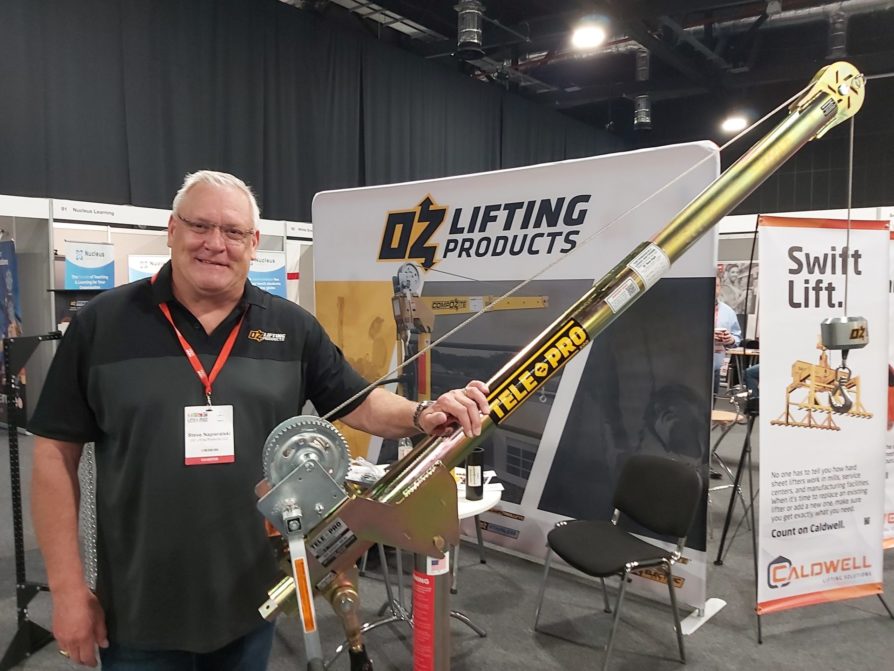
When AHR Expo delegates – indeed, visitors to any exhibition – look at our wares, they only marvel in part at the product itself. What they really care about is how a CompOzite or CompOzite Elite carbon fibre davit crane, for example, helps them. As we know, composite tools are lighter and easier to transport primarily because of their material structure and strength-to-weight ratio.
More generally, modern materials, like composites, are remarkable, but their real value always comes from what people do with them. Engineers, technicians, and fabricators turn raw potential into solutions, designing, shaping, and assembling components that solve problems, improve safety, and deliver performance that would otherwise be impossible. The materials are impressive; the human mind and hand make them transformation.
Mind your head
I particularly like HVACR as a case study as tight spaces and low headroom are the rule, not the exception. We’ll immerse ourselves in the industry once more at the Canadian Mechanical & Plumbing Exposition in Toronto this month. It’s where the modern world and ergonomics combine – or perhaps more accurately, collide. Ceilings, ductwork, and building infrastructure set the stage, and technicians navigate these constraints every day. One can be in the tallest or most state-of-the-art building in the world but working around pipework or plumbing equipment is going to be a challenge that needs to be overcome. If someone has paid $5 million for an apartment or $500-a-night for a hotel room, they’re not going to take kindly to not having hot water or air conditioning.
The lessons from HVACR, trade shows, and decades of ergonomic progress are clear: technology, materials, and automation are only as effective as the people using them. Lifting aids, composite materials, robotics, and AI can transform what is possible, but they cannot replace judgement, skill, and adaptability. True best practice places humans at the centre, designing workflows, tools, and environments to reduce strain, improve safety, and maximise efficiency. By keeping ergonomics, training, and human capability front and centre, industry can continue to innovate, meet regulatory demands, and deliver performance, all while protecting the workforce that makes that innovation real.
ILH free trial
Click here to get your free copy of ILH magazine and the bi-weekly e-Newsletter
New Issue
ILH September 2026
In this month's issue