
)
The alternate timeline
Mobile lifting equipment continues to embrace alternative fuel systems, from low-carbon diesel to hydrogen fuel cells. But at what point does the alternative become the norm?
At some point, fossil fuels will become the alternative fuels, as lower-carbon power trains take over as the solutions of choice. However, the market remains fractured, with no single technology emerging as the clear winner in the sustainability race.
Lithium dominance
The rise of the electric car, truck and bus has led to lithium-ion dominating the vehicles segment. But when it comes to off-highway equipment, the picture is much more fragmented.
Lithium certainly owns a substantial share of the alt-fuels market, in part thanks to the work done by the automotive sector. Its investment of billions of dollars in R&D led to leaps forward in reliability, performance, and – perhaps most importantly – cost.
From lift trucks and telehandlers to MEWPs, most manufacturers now offer a lithium version of at least some products. And the battery packs are becoming increasingly bespoke, tailored to ensure high performance for each specific product or task.
Industrial material handling equipment OEM Clark Europe recently revealed its new Fusion lithium-ion battery. This is designed to power its entire range of industrial trucks, meaning it must work with both 48V and 80V architectures.
At LogiMat 2026, Clark also unveiled a new multi-voltage charger that can handle both voltage classes. The company’s stated aim was to future-proof existing forklift fleets, from 48V models in its compact S-Series to the 80V models at the high end of the S-Series, along with its Raider and Renegade trucks.
Clark’s thought process is that a single lithium-ion battery will have the same service life as several lead-acid batteries. Lithium also brings more flexibility to forklift operations as it is open to intermediate charging, something that actively harms lead batteries. In a multi-shift environment, opportune charging during breaks and shift changes can be highly cost-effective compared to returning a lead battery vehicle to the charge point for a full eight hours.
Conversely, MEWP manufacturer Skyjack remains focused on lead batteries, arguing that the higher costs for lithium are still not justified in this segment where opportune charging is less important.
“The Skyjack team has been monitoring the applicability, operational considerations, and cost efficiency of lithium batteries,” says Malcolm Early, vice-president, marketing. “At this stage we have found that developments in more traditional battery technologies remain more appropriate.”
Battery management
Integral to the increased performance and reliability of lithium is the battery management system (BMS). Clark’s new BMS for its Fusion batteries includes a 4G module for remote monitoring and diagnostics, while the BMS also provides state of health data directly to the truck driver’s display. The main role of a BMS is to protect the battery from activities that can significantly impact its longevity, such as deep discharge and overcharging.
Battery management is a major focus of Italian company Flash Battery, which designs and builds battery packs for lifting equipment OEMs. “Industrial electrification is entering a new phase,” says Alan Pastorelli, co-founder and CTO. “Today the focus is no longer only on chemistry or cell format, but on how to manage batteries in an increasingly intelligent, safe and predictive way throughout their entire lifecycle.”
The company has recently enhanced its proprietary BMS, branded as the Flash Balancing System. This already included patented technology to enable battery cell balancing at high power. This improves cell uniformity, which is vital to battery pack lifespan and overall performance.
It recently secured a new patent for technology that measures cell impedance. Impedance is an electrochemical parameter that changes over time as the battery ages and provides valuable insight into the internal condition of the cell.
By integrating electrochemical impedance spectroscopy (EIS) data into the BMS, Flash Battery can provide a more detailed and accurate picture of battery state of health. Before this technology, state of health was generally estimated by combining several parameters, including residual capacity, voltage, current and temperature.
“Impedance spectroscopy adds an entirely new layer of information because it provides direct insight into the electrochemical evolution of the battery cells,” says Alan. “This enables earlier detection of degradation mechanisms, more accurate estimation of remaining useful life and further improvements in predictive maintenance capabilities.
“Rather than calling it the ‘missing link’, we see it as another important building block towards a more comprehensive understanding of battery health. Its real value comes from combining impedance data with all the other information collected by the battery management system and the Flash Data Centre, enabling increasingly accurate models of battery behaviour throughout its entire lifecycle.”
While EIS has been widely used in laboratory environments for many years, Flash Battery’s innovation lies in making this technology suitable for continuous operation in an industrial machine, without requiring external laboratory equipment.
“Achieving this milestone was possible because we develop the entire BMS architecture internally, including electronics, firmware and software,” adds Alan. “This gave us the flexibility to design a system capable of performing highly accurate impedance measurements under real operating conditions.”
This was made possible by the extensive information housed in its Flash Data Centre, which monitors thousands of batteries already in operation. This enabled its R&D team to correlate impedance measurements with real-life battery behaviour in the field.
Flash Battery is also deploying AI on data analytics. “Our AI and machine learning algorithms identify correlations and behavioural patterns that would be impossible to detect manually, continuously improving the accuracy of our state of health models,” says Alan.
“This enables increasingly predictive maintenance, earlier identification of potential anomalies and more effective planning of battery lifecycle management. For OEMs, the benefits are tangible: higher machine reliability, reduced unplanned downtime, data-driven maintenance decisions and a lower total cost of ownership across the entire fleet.”
Integration importance
However, Flash Battery understands the battery and BMS do not operate in isolation within a machine’s architecture. To this end, it recently signed a new partnership with ETP, an established electrification specialist in the Nordic region. ETP has a strong track record on systems integration for industrial vehicles and material handling equipment.
The partners aim to create an ecosystem where batteries, power electronics and software operate as one seamless system. It is wise move by both parties as northern Europe remains one of the most advanced markets for industrial electrification.
Flash Battery believes that, in this region, OEMs are no longer simply looking for components, but for partners capable of supporting them throughout the entire development process, from application analysis to final system validation.
“For us, it was essential to find a supplier capable of adapting the technology to the customer’s real needs and applications, an area where Flash Battery has demonstrated significant strength,” says Christer Sigurd CEO of ETP. “We also highly value that Flash Battery is a European company with full ownership and control of its own technology and development, ensuring high quality, flexibility and long-term innovation capability.”
Flash Battery offers a modular battery platform, offering the same integration approach regardless of the required battery size. “This provides scalability, efficiency and a streamlined implementation process for customers across different applications,” adds Christer.
Flash Battery is keen to point out that this is not a traditional distribution agreement. Instead, the collaboration aims to build a strong technical and application support structure capable of guiding Northern European OEMs through every phase of their electrification projects, from system architecture definition to complete integration.
The objective is to provide the Nordic market with a more structured, customer-focused approach capable of supporting increasingly sophisticated projects, from prototype development through to serial production.
Both partners understand that electrification is no longer simply a technological transition. It represents a structural transformation in the way future industrial machines are designed.
In this scenario, value will not be determined by individual components, but by the ability to combine technology, expertise and market knowledge to accelerate electrification in a sustainable and effective way.
“Together, we can support OEMs with a truly integrated approach, transforming technological complexity into reliable and practical solutions,” says Marco Righi, founder and CEO of Flash Battery.
Increased demand
While the robustness of lithium has long been recognised, other factors are now also driving sales growth.
Rising fuel prices due to the ongoing US-Iran conflict are certainly playing a part, according to MEWP manufacturer Niftylift.
“Fuel-price volatility has added further momentum to interest in battery and hybrid machines, but the shift was already well underway before the latest conflict in the Middle East,” says Tom Hadden, global technical sales manager. “The pace varies considerably from market to market, depending on energy costs, charging infrastructure, emissions legislation, customer expectations and site requirements, but overall, we’ve seen a clear positive trend towards all-electric and hybrid solutions.”
Niftylift sees that fuel cost is only one of many pressures shaping the industry. OEMs are also managing tariffs, shipping disruption, rising supply-chain costs, regional regulation and increasing global competition. “It will be interesting to see how these pressures ultimately influence equipment pricing and rental rates, particularly as demand for cleaner, more advanced machines continues to grow,” adds Tom.
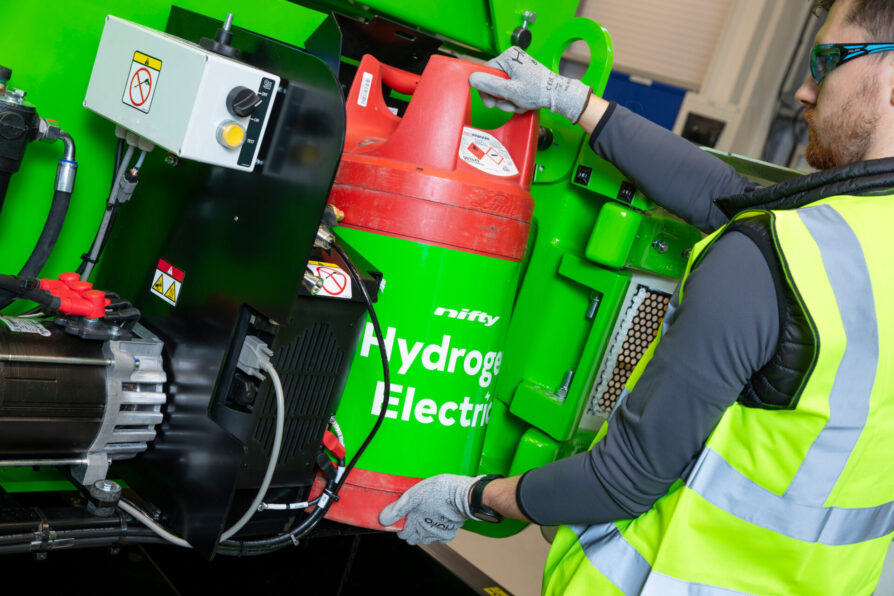
It is important to remember that this demand is not solely focused on lithium machines. Niftylift’s range of lightweight boom lifts runs from HVO-ready hybrids to hydrogen power.
The company has worked closely with Speedy Hire to develop and perfect a boom lift powered by a hydrogen fuel cell.
“For Niftylift, hydrogen MEWPs are not a future concept. They are already in mainstream production alongside our other products, driven in large part by Speedy Hire’s investment through its Velocity strategy,” says Tom. “Speedy’s commitment has helped move the technology from development into genuine fleet operation, while we’ve also supplied hydrogen machines into a number of export markets. Being first to market has given us invaluable real-world experience and reinforces our strategy of giving customers the widest choice of safe, sustainable power solutions.”
The lightweight, compact design of Niftylift’s self-propelled booms proved to be ideal for incorporating hydrogen technology – and Tom states that this was achieved without compromising the machine’s transportability, performance or practicality. “MEWPs could therefore be among the earliest adopters of hydrogen in construction, particularly compared with higher-consumption earthmoving and excavation equipment,” he adds.
As the pioneer in hydrogen boom lifts, Niftylift has also learned plenty of lessons along the way. “The biggest lesson has been that hydrogen is not just a technology challenge,” says Tom. “Infrastructure, refuelling, operator perception and site acceptance are equally important. Building confidence and knowledge in these areas is essential so hydrogen can ultimately be treated like any other fuel.”
Product diversity
At the other end of the spectrum is HVO, designed as a like-for-like replacement for diesel, but with a fraction of the greenhouse gas emissions.
“HVO has proved to be a practical way for customers to reduce emissions without changing the way they operate their fleets,” adds Tom. “We’ve seen the strongest uptake on major infrastructure projects and sites with ambitious sustainability targets, where customers want immediate carbon reductions from existing equipment.”
He highlights how Niftylift’s lightweight, compact machine designs and its Gen2 Hybrid technology already deliver industry-leading fuel efficiency. “Combining these with HVO provides another meaningful step in reducing emissions,” he says.
Niftylift’s approach encapsulates the challenges faced by all OEMs. As of yet, there is no silver bullet to achieving sustainability in lifting equipment. Different applications require different approaches, meaning different drive trains.
“We don’t believe there will be a single technology that fits every application, which is why our focus is on giving customers genuine choice, backed by engineering that delivers lower emissions without compromising performance or safety,” says Tom.
“Alongside battery-electric, hybrid, hydrogen-electric and HVO-compatible products, we’re continuing to explore other emerging low-carbon technologies to ensure customers can make meaningful progress towards net zero in a way that suits their business.
“It’s about offering customers the broadest range of practical solutions, enabling them to choose the right machine and power source for their application, wherever they operate in the world.”

ILH free trial
Click here to get your free copy of ILH magazine and the bi-weekly e-Newsletter
New Issue

ILH September 2026
In this month's issue