
)
Robot wars
We have witnessed huge advances in automation technology in the past few years. But are industrial facilities fully embracing AGVs and automation? Or are some still hesitant to make such big investments?
The recent LogiMat show once again demonstrated that automation of warehouse lifting equipment is an unstoppable trend. From major manufacturers to start-ups, there was an immense range of automated guided vehicles (AGVs) and fully autonomous mobile robots (AMRs) on display.
However, behind the headlines and impressive new products, there remain concerns over adoption rates.
Project delays
It is no secret that geopolitical upheavals will lead companies to pause their major investment plans. And in many cases, automation falls into that category.
“Our sales teams work with both OEMs and end users, so we have a pretty good ear to the ground,” says Matt Wade, VP of marketing for Bluebotics. “Interest levels in automation have not changed. There has just been more delay when it comes to pressing ‘go’ on a project. Sometimes it is just a project on a single site, but more often it is part of a far larger, global project, which can lead to more caution.
“However, the overall trend remains positive. And with inflationary pressures on many markets again, that makes automation become even more interesting.”
This viewpoint is confirmed by Pramac. “We are getting more and more enquiries,” says Maik Schroeder, part of its sales team in Germany. “We cannot realise all the projects immediately, but for sure a lot more people are gathering information and preparing budgets for automation.”
This is frustrating for suppliers of AGVs and AMRs, because the industry had just started to gather some real momentum. “We entered the beginning of the mainstream maybe one or two years ago,” says Marcos Ribas Alvarez, sales manager for VisionNav. “The first two months of 2026 have seen some projects get delayed, so let’s wait and see.”
Increased competition is also playing a part. “For example, if there are 100 projects and 100 suppliers, it is only one project each,” says Arjan van Zanten, VP automation, Europe for EP Equipment. “But the market for forklifts is 1.5 million units per year, so there is huge potential.”
New technology
Despite these temporary delays, OEMs and their suppliers continue to invest in developing new technologies.
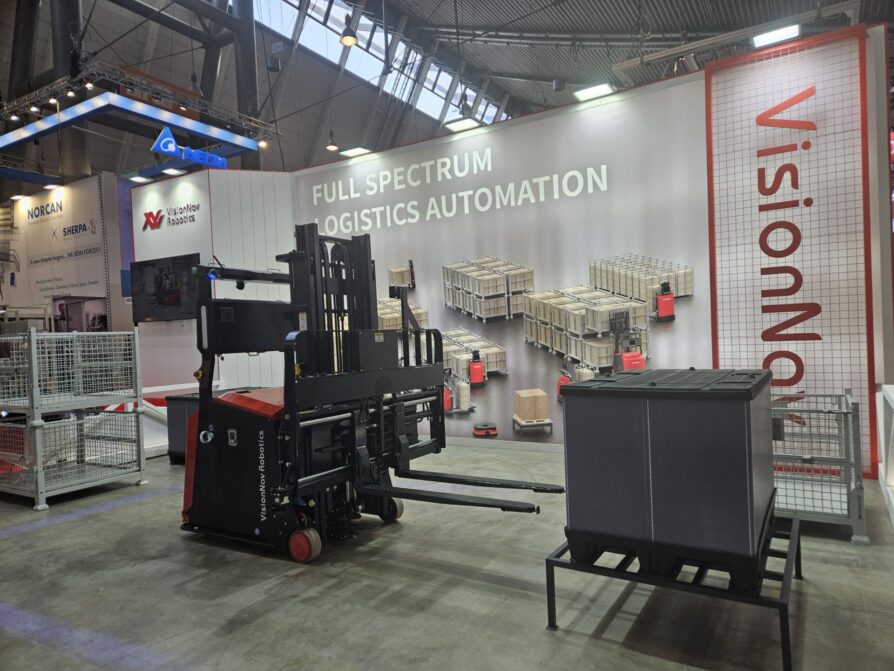
VisionNav specialises in AMRs and AGVs for logistics applications. It has developed nine product series to address full-stack material handling scenarios and has more than 750 projects deployed across more than 30 countries. At LogiMAT 2026, VisionNav Robotics unveiled its new VNP15-66 counterbalance stacker AGV and VNK15 Platform AMR.
The drive to deploy AMRs and AGVs is also impacting the OEMs’ supply chains. “The modern logistics landscape presents increasingly complex challenges that require innovative, efficient solutions,” says Marco Righi, founder and CEO of Flash Battery.
“Competitors in the industry must deal with the need to ensure continuous operation of machines 24/7, so it’s essential to optimise recharging times and operating and maintenance costs. This modern landscape has laid bare all the limits of traditional lead-acid batteries and underscored how lithium is now the primary ally of electrification.”
An important benefit of using lithium batteries in automated logistics is the elimination of the need for battery swaps – the replacement of an empty lead battery with a charged one.
“Due to the long recharging times required by lead-acid batteries, swapping batteries used to be essential to ensure the operational continuity of forklift trucks, AGVs and LGVs operating in logistics facilities,” says Marco. “But lithium batteries have revolutionised this limitation thanks to their ability to support rapid charges and opportunity charging during breaks.
“This way it’s possible to keep only one battery inside the machine, completely eliminating the space dedicated to recharging rooms and safety risks during battery replacement, with a consequent reduction in structure costs.”
The company says that its patented battery management system exceeds conventional systems by providing short, predictable charging times with especially short time for cell balancing, an important aspect of lithium battery health.
Meanwhile, BlueBotics recently launched SmartPass, a technology aimed at preventing deadlocks, where AMRs will reroute when faced with an obstacle in their path, leading to traffic jams and deadlocks. “No matter how clean a site, and how well trained its staff, the paths of mobile robots sometimes become blocked,” says BlueBotics’ CEO, Dr Nicola Tomatis.
AGVs typically manage this situation by sending an alarm to an operator, while AMRs take any route possible, without limitation. “The first can lead to transport delays, the second to traffic deadlocks,” he adds. “SmartPass effectively bridges the gap between the two.”
SmartPass enables automated vehicles to follow virtual paths most of the time while performing pragmatic obstacle avoidance manoeuvres when blockages are detected.
“Rather than layering basic traffic management over obstacle avoidance functionality — which AMR producers have attempted with limited results – SmartPass does the opposite,” Nicola says. “We are confident this safe, prudent approach best meets the needs of industrial customers looking to deploy AGVs and AMRs in what are often high-traffic locations.”
Preparing the way
There are also still steps to take before automation that can improve a warehouse’s efficiency.
Zurich-based Sevensense Robotics has developed Alphasense Tracker. This camera-based real-time location system (RTLS) for forklifts works without the need for installing beacons, anchors, or infrastructure.
“What is special about it is, you don’t need any infrastructure, you just drive and map at the same time,” says Veronica Alonso Kannonikoff, marketing manager. “It takes less than one day to implement – and your own operations team can do it.”
It aims to address what Sevensense sees as a significant challenge for the industry. “There is currently a big gap between automated and manual operations in a warehouse. The automated operations by their nature provide streams of data that can inform insights. But while the warehouse manager will have assumptions about how efficient manual operations are, they cannot qualify them until now.”
Sevensense lets users integrate data from automated and manual operations into the same dashboard. “You go from having assumptions about how your warehouse works, to facts,” she adds. “With this added transparency you can further optimise your assets and also see where adding automation would make sense.”
BlueBotics, the automation and fleet management arm of Zapi Group, is taking a similar approach. It recently launched ANT locator, a platform enabling customers to track and optimise manual forklifts and their payloads.
“ANT locator also addresses an evolving challenge for internal logistics teams: how to ensure effective interactions between manual forklifts and driverless AGVs and AMRs,” says Nicola.
ANT locator sends live coordinates of manual trucks to BlueBotics’ ANT server AGV fleet manager. This precise positioning data enables the software to automatically manage interactions between automated vehicles, manual trucks, and even human staff. It achieves this by enabling traffic light systems for mixed vehicle types, smart interactions in pre-defined zones, and the integrated monitoring of all vehicles. This helps optimise transport flows by determining right of way and reducing risk of deadlocks or collisions.
German warehouse management software supplier SEP Logistik is an early adopter of ANT locator. “We use ANT locator in our RELAG-System to determine the exact position of each forklift,” says Markus Fischbacher, board member at SEP Logistik. “The system, which provides a real-time 3D visual of the warehouse to the operator, then can show them the most efficient path to reach their target location. ANT locator even enables us to offer this functionality outdoors.”
“On one project for example, thanks to the efficiency gains achieved, we enabled a sheet metal producer to reduce the number of forklifts they required by 20%. With ANT locator inside our RELAG-System, our customers can enjoy greater intralogistics transparency and traceability, without needing to leave the office.”
Simplifying deployment
The same mantra of keeping it simple is growing in volume, as suppliers seek to re-engage with customers who view automation as too complex – or who have even seen automation projects fail.
“Most automation projects with autonomous forklifts fail before they even get started,” says Stefan Dörr-Laukien, CEO & co-founder at Node Robotics. He believes that hurdles such as complexity, cost and dependence on external support are all factors in failure – along with the ROI horizon being too distant.
“You learn something from every project and every client,” he adds. “After a while, certain patterns become hard to ignore. The main barrier to wider mobile robot adoption in industry is rarely the core technology. Navigation, sensors, and control systems have all improved significantly over the past years.
“The harder problems are deployment and operation – getting systems running reliably in real facilities, keeping them stable as layouts change, and doing all of this at a cost that actually makes sense for operators.”
Node has therefore transitioned from being a software provider to OEMs to producing its own AMR. The company’s new Forky15 works on a ‘plug n play’ model that requires no infrastructure changes or teams of specialists on site for months. This is due to its proprietary Node.OS software which enables the user to configure routes stations and workflows themselves. This promises ROI within 12-18 months, even for single shift operations.
“In some market segments, the hardware is simply not designed with ease of deployment and operation in mind,” he says. “In others, the integration between software and hardware components leaves little room to improve overall system behaviour. You can solve parts of the problem – but not the whole thing. That is where our thinking started to shift.”
Instead of only adapting its software to existing vehicles, Node began asking a different question: what would happen if the software sat at the centre and the hardware followed from there – with the explicit goal of making deployment and operation simple enough to reach the operators who currently don’t have access to this technology?
“Going from a software-only company to building complete systems is not a small move,” he adds. “We have already hit some walls, and there will certainly be more. But the conversations we are having with potential users, partners, and integrators are encouraging. More importantly, working on the full system lets us solve problems end-to-end that previously sat outside our reach. That is what makes this direction worth pursuing.”
Easy transition
EP Equipment’s automation division, X-Mover, outlines an approach focused on simplicity and practicality for businesses of all sizes. Instead of complex projects and overengineering, its goal is easy transition from manual and semi-automated environments to fully automated and intelligent operations.
“If you can automate your operations in just two weeks and can have ROI in less than one year, why are we not having more discussions about automation?” says Arjan. “The best day to automate was yesterday, but the second-best day is today. Companies can now pick a solution that exactly matches their ambition and budget.”
He believes that part of the hesitancy to adopt automation is because some elements of the industry market it as being very complex. “All the consultants and ‘experts’ preach the same language,” he says. “Too many are offering systems that are highly complex, that are marketed as being able to do everything. So of course, a lot of the customer base believes that automation is complex. We want to show them that it can be simple, and it can be up and running next week.”
Culture change
While the technology is here now, EP Equipment believes that European culture must change before we can make the most of automation. “We need to make a paradigm shift,” says Arjan. “In Europe, I don’t believe we have truly grasped or understood what automation means yet. This is not the 1900s any more when businesses relied on low paid workers in warehouses and on assembly lines.
“In China, they automate by default. Their view is, why would you let a person drive the truck if the truck can drive itself? In Europe, we still use people by default – in China, they think we are crazy.”

ILH free trial
Click here to get your free copy of ILH magazine and the bi-weekly e-Newsletter
New Issue
ILH September 2026
In this month's issue