)
Positive vibes
More electric boom lifts are making their way into the MEWP market. But what is the dominant battery technology – and is hybrid a safer bet than all-electric?
“The customer is always right, in matters of taste” – a maxim by which the retail sector has lived for more than century. And when it comes to electric boom lifts, it is also the motto of MEWP manufacturers.
Today there is a wider choice than ever before, with articulating and telescoping electric booms for a broad range of applications. And crucially, there are very different drive train technologies, tailored to suit different needs.
“While lithium-ion batteries have largely become the preferred choice for electric boom lifts, there are still specific cases where lead acid batteries – especially AGM – may be a better fit,” says Hyman Yu, Sinoboom’s head of its new product management centre, based in Toronto.
Hyman cites five key benefits of lead batteries over lithium, starting with lower up-front costs, which is a priority in certain regions – he says that lead batteries can be 50% to 70% cheaper. In the same vein, lead batteries have simpler, cheaper charging infrastructure which is widely used and standardised.
The third benefit is proven durability in extremely cold environments, whereas lithium battery packs require thermal management to avoid a capacity drop or charging issues at temperatures below circa 0°C. And at the other end of the spectrum is fire risk. “Lead-acid is chemically stable – it does not suffer from thermal runaway or fire risks like lithium-ion can if damaged or improperly charged,” he adds.
The last is increasingly important – end-of-life recovery and recycling. “Lead-acid is almost fully recyclable (98%+ globally), with well-established recycling networks,” he says. “Lithium-ion is harder and more expensive to recycle, and disposal remains an issue.”
For the counterpoints, we asked Dominik Damm, Genie’s director of product management booms portfolio. While he agrees that flooded lead acid (FLA) batteries have a lower purchase price, there are some hidden operational costs.
“Unlike lithium, lead acid batteries require ongoing maintenance,” he says. Lithium batteries also last much longer than lead acid batteries and require far less maintenance. “The initial cost of lithium is recouped by the owner over the life of the battery,” he adds. “For example, replacement cycles are much longer for lithium vs FLA.”
Genie’s own tests on its S-85 XC FE and E boom lifts found that run time on the original lithium battery exceeds 15,000 hours, which surpasses the second life of that machine. And of course, lithium battery prices continue to fall. “Eventually, economies of scale will take hold for lithium,” he says; “the initial cost of lithium will reduce, and it will provide even more value for equipment owners.”
Pingyong Qing, overseas product sales manager for Chinese manufacturer XCMG, sums up both sides. “In a nutshell, the lead acid battery wins in safety, durability, and working temperature range,” he says. “But lithium is the trend because of high power density and more mature technology. We have more and more customers who are asking only for lithium batteries.”
AGM alternative
Two manufacturers have chosen a middle ground of absorbent glass mat (AGM) batteries, offering the maintenance-free benefits of lithium but at a higher price than lead acid. Skyjack has adopted 415Ah AGM batteries as standard.
“In reality, the choice here falls between cost – both initial and developmental – and customer preference,” says Malcolm Early, vice president of marketing at Skyjack. “Our customer preference was for a more traditional solution from a familiarity point of view and from some apprehension on transportation and disposal issues.”
Niftylift also fits AGM batteries as standard to its electric booms. “While lithium batteries offer advantages such as longer lifespan and faster charging, these benefits are offset in our sector,” says Simon Maher, marketing manager. “Boom lifts require a minimum weight for stability. This means the lightweight benefit of lithium batteries provides no advantage,” he adds.
He also cites the lower upfront costs of AGM as more attractive to rental companies who are focused on a return on investment, along with the reliability and familiarity of AGM. “As a result, AGM remains the most practical choice for our customers today, balancing performance, cost, and operational needs,” he says.
Hybrid option
The other big question remains whether to go all-electric or adopt hybrid as the best of both worlds.
“Hybrids are very much still in the mix, especially as a bridge technology or when full electrification meets real-world constraints,” says Hyman. “Rental companies value hybrid machines because of their flexibility. The ability to do indoor and low-emissions work in electric mode but still have diesel power available for rough terrain or remote sites or long job cycles.
“Hybrid is especially relevant in markets, regions, and job types where charging infrastructure is imperfect, where terrain or job sites include remote or rough locations, or where grid power is unreliable. It allows mitigation of range or charging constraints.”
Hybrid booms can also provide cost savings by reducing fuel consumption. Genie says that its FE hybrid boom lifts use about 92% less fuel than diesel booms. “This allows an FE machine to work a full, standard work week on a single tank of fuel,” says Dominik.
Genie’s FE hybrid technology also uses the power generated in hybrid mode to recharge the machine’s battery, which means jobsites don’t need to worry about charging infrastructure. “An operator can run an FE boom lift in hybrid mode, charging the machine’s battery. In electric mode, Genie FE booms can work a full, standard workday – without emissions or noise – on a single charge,” he adds.
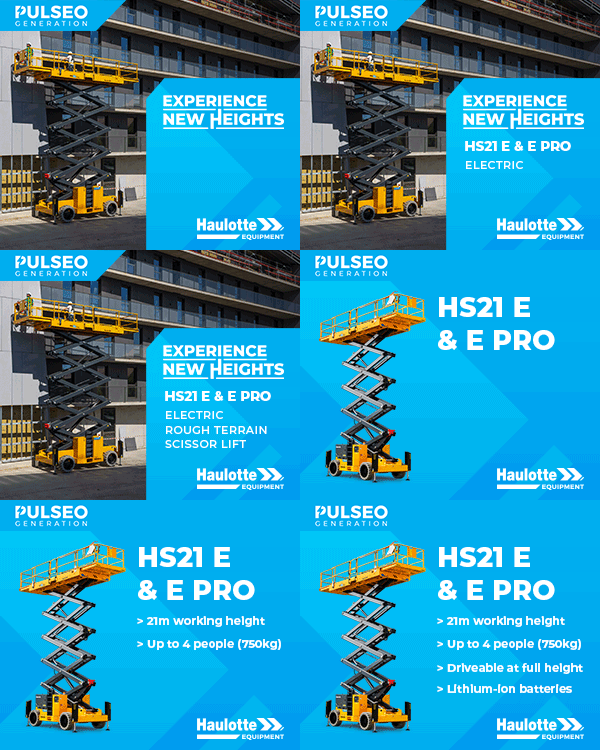
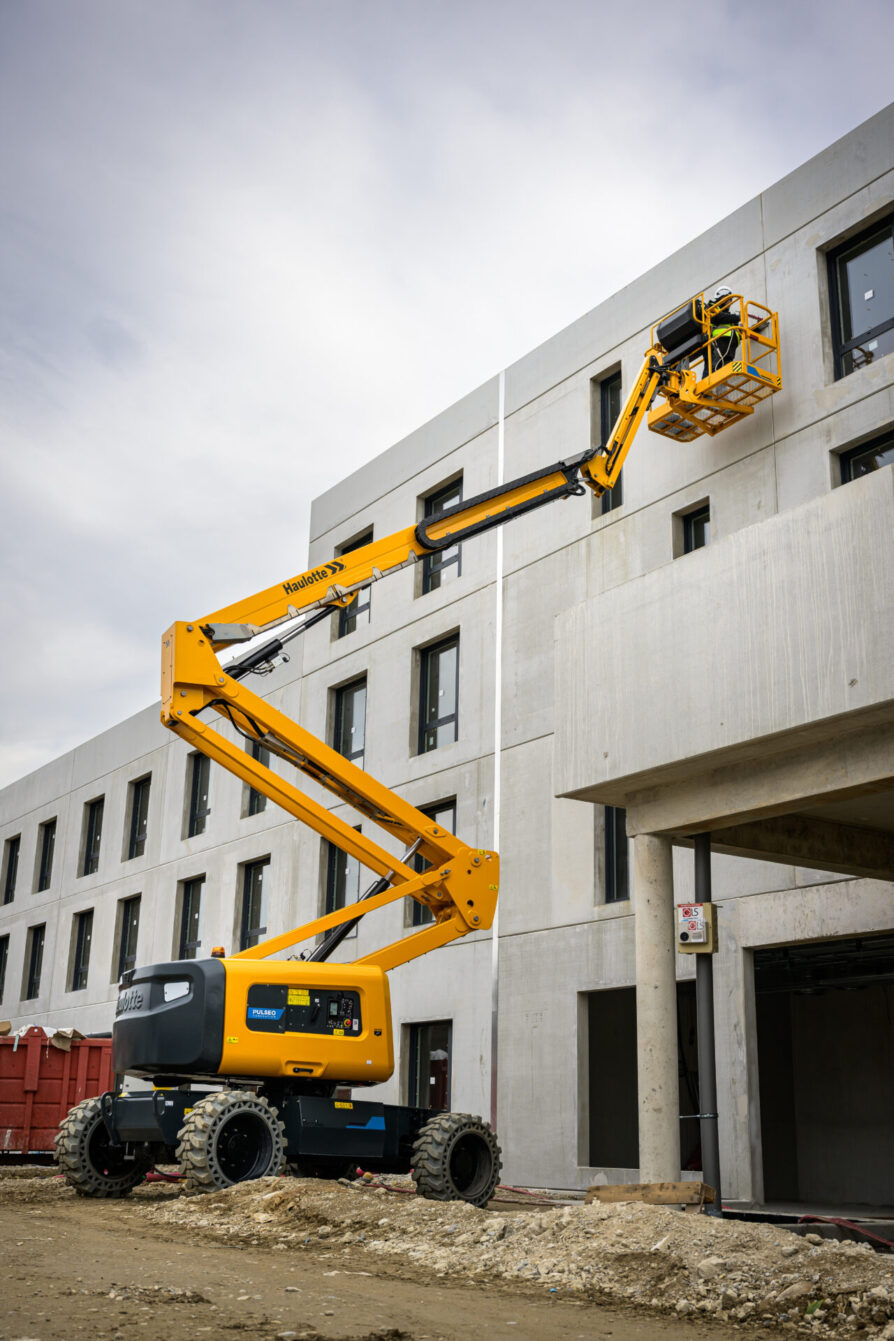
Haulotte addresses this with a removable range extender that is compatible across its Pulseo range of electric booms. “Hybrid rough terrain booms answer perfectly to the market ensuring full autonomy with or without access to a power grid,” says Cédric Faure, product manager.
For Skyjack, the mix of electric and hybrid booms is still evolving. “The fact that hybrid models remain in the mix is really reflective of some ‘anxiety’ over all-electric booms,” says Malcolm. “However, the picture is a little more complex as we see initial product offerings compromising on performance. In Skyjack’s approach, it was particularly important that we have a range of booms – diesel, all-electric, and hybrid-electric – that offer common specification and performance; so ultimately the customer has the choice.”
Meanwhile, XCMG remains largely focused on all-electric boom lifts; but it is developing prototype hybrids to meet regional market demands. “All our hybrid products are currently at a prototype stage, and are all sent to the market in UK, Germany, France, Turkey, and Italy,” says Pingyong. “The hybrid technology is currently not the preferred choice for end users, because of concerns of durability, maintainability, and complexity.”
Niftylift is seeing a clear trend from hybrid towards electric. “Where previously hybrids dominated, there is now significant demand for fully electric models across a much wider range of working heights and configurations,” says Simon. “Niftylift has been at the forefront of this shift, with highly efficient all-electric versions of nearly all our self-propelled booms.”
Other trends
Niftylift sees operator priorities focused around longer run times, greater efficiency, meeting tighter environmental regulations, and lower total cost of ownership. “The industry is moving decisively towards electric across more applications, with hybrid and bi-energy solutions acting as transitional technologies,” he adds.
Improving battery life and performance is vital to the transition to lithium from lead. “Only by doing so can we increase equipment runtime, speed recovery, and extend service life,” says Hyman.
Beyond that, other trends include developing and deploying a more efficient transmission system, as we see with the introduction of AC permanent magnet motors and electric cylinder transmission technology for lifting and steering. “These technologies can improve the conversion efficiency of electric energy, so that the same amount of electric energy can do more work,” he adds.
Thirdly, it is about being bigger and better – higher working heights and increased safe working loads in the platform.
Meanwhile, Genie sees product development trends as aligning with rental company priorities; equipment that delivers a low cost of ownership and high utilisation. “Electrification, reduced hydraulics, and new control systems will continue to be important developments,” says Dominik. “Each of these contribute to what customers want: equipment that’s easier and less expensive to maintain, has less frequent downtime, and retains its value.”
As an example, he cites the S-85 XC FE and E models, which featured more than 80 quality improvements to reduce maintenance. This resulted in a 15% reduction in ownership costs for E electric machines, and a 6% reduction for FE hybrid machines.
Another push for greater efficiency involves moving to a higher voltage system. “JLG has extensive knowledge of integrating electrical systems up to 100V,” says Nicola Sacchet, JLG’s EMEA product manager for booms, scissors and verticals.
“Larger machines with higher power requirements will require higher voltage systems to be efficient. As well as continuing to optimise current technology, higher voltage systems are the subject of ongoing research and development within JLG and other Oshkosh group companies. This will bring electrification solutions across the range of JLG and Hinowa booms.”
Alongside this will come rapid chargers, as we’ve seen for electric cars. “The automotive industry continues to innovate with higher power charging systems capable of supplying 350kW DC charging capability,” he says. “If you drive an EV, you will know the difference these high-power chargers make to the charging experience.”
He adds, “The target for automotive manufacturers is to replicate the experience of filling a fuel tank at a fuel station. Any breakthrough in the automotive sector will be reflected across other industries and ours is no exception. In any case, our challenge will remain the charging infrastructure.”
Genie’s Dominik agrees – but Genie limits systems to 48V to avoid additional red tape. “With lithium batteries, the chemistry and design allow manufacturers to reach much higher voltages in a single battery,” he says. “Genie intentionally sized our battery at 48 volts because higher voltages may require additional certifications. This makes it both easier to service and more economical for our customers.”
Adoption rates
However, even in mature markets, adoption rates can vary. China remains the global leader for electric booms by a significant margin. “China currently has an electrification rate of above 90%, making us the fastest growing market in the world,” says Pingyong. He believes that the country’s high rate of adoption is due to comprehensive charging facilities nationwide, government policies such as tax incentives, and government infrastructure investment.
For export sales, electric and hybrid make up a cumulative 25.35% of XCMG’s sales revenue, or 70.6% in terms of unit sales. “Overall, we believe the electric boom lift has proven its potential, and will continue to thrive, and show more presence in AWP markets,” he adds.
For Genie, it comes down to grid infrastructure investment. “It makes sense that countries with the most advanced electrical grid systems, such as China and those in the Nordic region, lead in the adoption of fully electric boom lifts,” says Dominik. “It takes infrastructure to support seamless charging of equipment.
Behind these leaders are European countries including Germany, France, and the UK. “Larger boom lifts require access to 220V output for faster charging, which is readily available in Europe,” Dominik adds. “By comparison, other markets, including the US, have established infrastructure that is based on 110V output, which can be a limiting factor.”
However, this opens the door for hybrid technology, which can bring many of the benefits of all-electric without the same reliance on grid infrastructure. “In North America there are reservations among rental companies about fully electric in all roles due to charging, job duration, and rugged terrain,” says Hyman. “Hybrid is seen as a safer bet for mixed environments. Also, some rental companies still invest in hybrids to cover a wider set of applications.”
Niftylift agrees that the US market has been slower to adopt all-electric booms. “This is partly due to lower fuel costs and less stringent legislation, which reduces the immediate economic incentive,” says Simon. “However, we are now seeing growing interest from American rental companies as major contractors increasingly demand low- and zero-emission solutions on large projects.”
The Middle East is also emerging as a fast-growth region for Niftylift, particularly for mega-projects that align with national sustainability initiatives such as Saudi Vision 2030 and UAE Net-Zero 2050.
Overall, electric and hybrid dominate sales of Niftylift self-propelled booms. “Today, the majority of Niftylift’s self-propelled boom sales are either hybrid or all-electric, with demand for traditional diesel-only models continuing to decline year on year,” he adds.
“We anticipate that within the next three to five years, the balance will shift further, with electric models representing the clear majority of sales in Europe, the UK, and other markets with strong sustainability policies. Hybrid will remain important in regions where charging infrastructure is limited, but its dominance will gradually give way to all-electric as confidence grows.”
In the Asia-Pacific region, Sinoboom is seeing faster growth in hybrid demand in countries where the grid is not always ready to support full electric. “Government policies may favour low emissions, but are perhaps not yet robust enough to support 100% electric in all cases,” says Hyman.
He cites several key reasons for slower adoption of electric booms. “Lower availability of capital and the higher upfront cost of electric boom lifts is a big deterrent,” he says. “Sparse or weak electric infrastructure makes operation more complicated, and regulations are often less stringent or less enforced regarding emissions and environmental standards. In many cases, diesel or fuel-powered equipment is cheaper for lease or total cost, especially where fuel is subsidised.”
Haulotte shares AEM data that shows in mature MEWP markets such as Europe, electric and hybrid machines have grown to a 16% share of the rough terrain boom segment. “Electric booms’ architectures are improving, together with new batteries technologies,” says Baptiste Roland, product marketing manager.
“Customers are more and more confident on the performance being equal to diesel booms and rough terrain capabilities of these new electric machines – and they are choosing electric booms for their versatility to operate anytime and everywhere.
“Compared to diesel booms, our electric machines are proposing a simpler architecture – hydraulic hoses and inverters reduced, for instance – that means they are less expensive to maintain and, in the end, a better total cost of ownership for our customers. This is the key to facilitate and boost the adhesion on electric RT booms.”
While Genie does not discuss specific sales numbers for its products, it notes that hybrid and electric boom lifts combined represent a significant and growing volume of boom lift sales.
“We know that electric or hybrid equipment from Genie saves owners money through higher utilisation rates, lower maintenance and fuel costs, and overall better total cost of ownership,” says Dominik. “Those operational and financial efficiencies are the key reasons demand for electric and hybrid equipment continues to grow.
“That said, there is demand for all three power options – electric, hybrid, and diesel – and our intent is to allow our customer to choose what’s best for them.”
XCMG believes that innovation is now moving beyond simply how the boom is powered. “Innovations in battery technology and drive train system are the core driving forces, while the enhancement of intelligence and safety being significant features,” says Pingyong. “The intelligent features such as real-time monitoring of equipment status, remote diagnostics, and fault warnings reduce the fault response time from two hours to 15 minutes, aiming to improve the user’s ownership experience.”
End of life
In many respects the rise of electric boom lifts mirrors that of electric cars. Grid infrastructure to support charging is vital to encourage adoption; and some customers retain ‘range anxiety’ concerns over performance. However, could we also see another trend transfer from EVs to electric booms: end-of-life battery management? In some regions, the automotive OEM is now responsible for disposal of the battery at the end of the vehicle’s life.
“End-of-life (EOL) strategy for lithium batteries in electric boom lifts is an increasingly important and sometimes unclear issue, especially as adoption accelerates,” says Hyman.
His view is that the MEWP manufacturer provides guidance on battery lifespan and recommend disposal paths such as recycling. However, in most regions the rental company or MEWP owner is viewed as the battery owner and is legally responsible for battery disposal.
Some MEWP OEMs are being proactive on this issue. “Genie recognises that there is a learning curve for customers regarding proper maintenance, storage, recycling, disposal, and handling of lithium batteries,” says Dominik. “To assist customers, Genie has created documentation for managing lithium batteries with practical tips.”
XCMG works with its battery suppliers to ensure responsibility. “We do assess the battery disposal policy on the manufacturer’s side while sourcing our battery suppliers and evaluate them regarding this subject on a strict manner before approving the suppliers in our short list,” says Pingyong. “The battery manufacturers are held accountable for the laws and regulations of the country of destination. The OEM does not participate in the implementation stage.”
While the vast majority of Niftylift electric and hybrid booms use AGM batteries, the company has put procedures in place to deal with lithium. “The question of lithium end-of-life applies only in limited contexts, such as custom projects or future developments,” says Simon. “Where lithium batteries are used, responsibility is typically shared.”
Niftylift acknowledges that OEMs must ensure compatibility with existing recycling and recovery processes, while rental companies and end users hold responsibility for ensuring batteries are returned through the correct channels at the point of replacement.
“This collaborative approach ensures that environmental benefits are not offset by disposal challenges.”

ILH free trial
Click here to get your free copy of ILH magazine and the bi-weekly e-Newsletter
New Issue
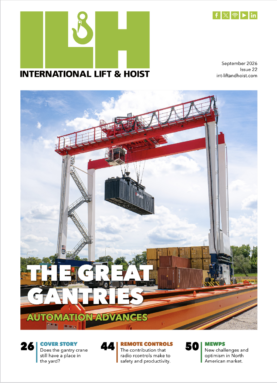
ILH September 2026
In this month's issue